







Blog
How to Unclog a Disposable Vape

To check a clogged disposable vape, inspect the mouthpiece and external air inlets, remove only the shipping covers identified in its instructions, and wipe away visible debris from accessible outer surfaces with a dry cloth or tissue. Keep cleaning outside the device. If the draw stays blocked, contact the manufacturer instead of opening the housing or pushing a tool into the airway.
First establish what “clogged” means. A device that is physically difficult to draw through needs a different check from one that allows air through but produces no vapor. Liquid in the mouthpiece, a burnt taste, or unusual heat also changes the next step. This guide is for adult users checking a sealed disposable device; the exact model instructions take priority.
Is the Disposable Vape Actually Clogged?
A tight draw is an observation, not a diagnosis. Check for a visible obstruction before deciding that something inside needs clearing. A screen or light can provide additional information, but its meaning depends on the model. Avoid assuming that every blinking light means a blockage.
LOST MARY’s current troubleshooting guide distinguishes airflow problems from power, liquid, and device faults. It recommends checking for packaging material or visible obstructions and seeking support if the problem persists.
| What you notice | What to consider | Appropriate next step |
| The draw feels unusually restricted | An external opening may be covered or obstructed | Inspect the mouthpiece, intended air inlets, shipping covers, and your grip |
| Air passes through, but no vapor appears | Battery, liquid, settings, or a fault may be involved | Check the model instructions and documented indicators |
| Gurgling, spitting, or visible liquid | Do not assume this is a simple dry blockage | Stop using it and follow the manufacturer’s guidance |
| A burnt taste despite airflow | Clearing an opening does not establish that the wick is usable | Stop and assess liquid depletion or device failure |
| Heat, swelling, damage, or self-activation | A possible device or battery fault | Stop using and charging it; seek appropriate support |
Use the table to choose a path, not to identify an internal part from a symptom alone. A sealed device does not give you enough access to confirm every possible cause at home.
How to Check a Clogged Disposable Vape
Work in good light, with clean, dry hands. Disconnect any charging cable before checking the exterior. If the device is leaking, damaged, unusually hot, or activating by itself, skip routine cleaning and follow the stop-use guidance below.
1. Identify the Exact Model
Find the model name on the packaging or device and check its official instructions. Look for the intended mouthpiece, air inlet locations, any adjustable airflow control, and removable shipping protection. A hole near the base is not automatically an air inlet, and a fixed cap is not automatically removable.
This matters because advice for refillable tanks and detachable pods may describe parts a sealed disposable does not have. Follow the instructions for the device in your hand, rather than a repair video for a similar-looking product.
2. Check for Intended Shipping Covers
For a new device, compare it with the unpacking instructions. Some models arrive with a mouthpiece plug or protective sticker that must be removed before use. For example, the GEEKBAR HERO user manual identifies a top silicone plug and bottom sticker for that particular model.
Remove only items the manufacturer identifies as shipping protection. Do not peel away the housing, lift a gasket, or pull out an unfamiliar piece because another device uses a different arrangement. Keep removed packaging away from children and pets.
3. Inspect Accessible Outer Surfaces
Look at the mouthpiece rim and the exterior around the documented air inlets. If loose lint or debris is visible on an accessible outer surface, wipe it away with a dry, lint-free cloth or tissue. Wipe across the surface so you remove debris from the edge; do not push it down an opening.
Do not insert a pin, needle, toothpick, or other tool. LOST MARY’s guidance specifically warns against sharp objects and opening the device. If clearing the outside would require reaching into the airway, stop at that point.
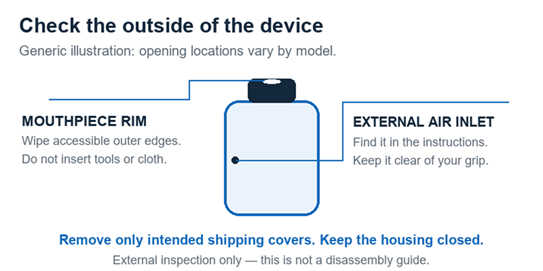
Opening locations vary. Inspect accessible outer surfaces and keep tools out of the airway.
4. Check Your Grip and Any Intended Airflow Control
Compare your normal grip with the inlet locations shown in the instructions. Make sure a finger, removable sleeve, or other accessory is not covering an intended opening. If the model has an airflow adjustment, use only the documented control and position.
Do not drill a larger inlet or try to create a new opening. A model without adjustable airflow cannot be given that feature by following instructions for another device. The goal of this check is to remove an external obstruction from the intended air path.
5. Stop if the Restriction Remains
Recheck the exterior visually. If the device still appears blocked, or normal use according to its instructions remains difficult, do not keep pulling harder to force it through. An obstruction you cannot reach externally belongs with manufacturer support, not an improvised repair.
If the draw returns to normal but vapor does not, move to the battery and liquid checks below. Resolving an external restriction does not prove that the rest of the device is working correctly.
What if Air Flows but There Is No Vapor?
Treat normal airflow with no vapor as a separate problem. Check whether the model requires an intended activation step, what its indicator means, and whether its battery or liquid display shows depletion. A lit screen alone is not a complete diagnosis.
For a rechargeable model, follow its official charging method only if the device is undamaged and otherwise suitable for charging. Our guide to how long to charge a disposable vape and when to unplug explains why timing and completion signals vary. Charging is not an airflow-cleaning method.
Also assess whether the device has reached the end of its liquid supply. Read how to tell if your disposable vape is almost empty for the distinction between battery and liquid depletion. Recharging cannot replenish a sealed liquid reservoir.
If the device tastes burnt, stop using it. Our article on what to do when a disposable vape tastes burnt explains why clearing an opening cannot repair a damaged wick. Avoid repeated test puffs while trying to identify the cause.
Unclogging Methods to Avoid
Do not use a hair dryer, heater, microwave, hot water, or a freezer as an unclogging technique. The FDA’s vape battery precautions advise following manufacturer instructions and avoiding extreme temperatures. Temperature-based tricks are not a substitute for a documented cleaning procedure.
Keep water, alcohol, and cleaning sprays out of the device. Do not rinse a sealed disposable or dismantle it to clean the internal air path. Electrical Safety First’s vape guidance warns against immersion, modification, crushing, and puncturing.
Likewise, do not blow forcefully into the mouthpiece, use compressed air, or try to clear a suspected blockage with repeated hard draws unless the exact manufacturer instructions explicitly provide a suitable procedure. A removable pod’s maintenance routine should not be transferred to a sealed disposable by guesswork.
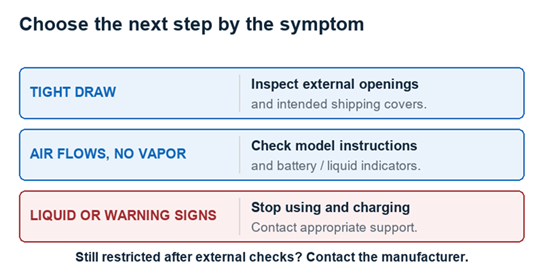
Restricted airflow, no vapor, and liquid or battery warning signs call for different actions.
When Cleaning Is No Longer Appropriate
Stop using the device if it leaks, spits liquid, or activates by itself. LOST MARY’s troubleshooting guidance advises stopping in these circumstances rather than continuing to use a leaking or faulty device. Do not charge it as a way to test whether the fault disappears.
Unusual heat, bulging, or hissing also calls for stopping. London Fire Brigade’s vaping guidance identifies these as battery warning signs. If smoke or fire develops, leave the area and contact local emergency services; do not continue troubleshooting.
Avoid touching leaked liquid. If e-liquid gets on your skin, wash thoroughly with soap and water. The FDA’s accidental e-liquid exposure guidance also explains why devices and liquids must be kept away from children and pets. Washing exposed skin does not mean washing the device.
For a replacement or warranty enquiry, record the model, when the problem started, any displayed message, and the external checks completed. Keep the receipt and packaging if available. Photographs of the label and exterior can help support identify the product; there is no need to open it to provide that information.
When disposal is necessary, check local collection arrangements. In the United States, the EPA advises taking e-cigarettes to appropriate household hazardous waste collection, rather than household trash or ordinary recycling. Follow the collection service’s instructions for a damaged device.
Frequently Asked Questions
Why is my brand-new disposable vape hard to draw through?
First check the model’s unpacking instructions for an intended mouthpiece plug or inlet sticker. Inspect the exterior and confirm that your grip is not covering an air inlet. If those checks do not resolve it, contact the seller or manufacturer rather than opening a new sealed device.
Can I use a needle or toothpick to unclog the mouthpiece?
Do not insert either into a sealed disposable. Keep cleaning on accessible outer surfaces and remove visible debris with a dry cloth or tissue. A blockage farther inside requires manufacturer guidance, not a tool pushed through the mouthpiece.
Does charging fix a clogged disposable vape?
Charging restores battery energy in a device designed to recharge; it does not remove an obstruction. If air flows normally but no vapor appears, check the documented battery and liquid indicators separately. Do not charge a leaking, damaged, or overheating device.
Is gurgling proof that the vape is clogged?
No. The sound alone does not identify an internal cause. If there is spitting or unusual liquid in the mouthpiece, stop using the device and consult its manufacturer. Do not assume that stronger suction will make it usable.
Should I warm a disposable vape to clear it?
Do not apply heat as a repair method. Avoid temperature extremes and follow the storage instructions for the exact model. A device exposed to water, damage, or unusual heat needs appropriate assessment, not a heating or cooling experiment.
Can I remove the mouthpiece for deeper cleaning?
Only remove a component if the official instructions explicitly identify it as user-removable and provide the procedure. For a sealed disposable with no such instructions, do not pry off the mouthpiece. Instructions for a detachable pod are not interchangeable.
What should I do if it keeps clogging after external cleaning?
Stop repeating the cleaning attempt and contact support with the model details and symptoms. Recurring restricted airflow, liquid, or abnormal operation needs assessment. If the device must be discarded, use an appropriate local collection service instead of household trash.
Sources and Further Information
Official manufacturer and public safety guidance checked October 12, 2026. Model examples apply only to the named device; disposal arrangements vary by location.
- LOST MARY — Why Is My LOST MARY Not Working?, published August 26, 2026.
- GEEKBAR — HERO User Manual.
- FDA — Tips to Help Avoid Vape Battery Fires or Explosions.
- Electrical Safety First — Vapes and E-Cigarettes.
- London Fire Brigade — Vaping and E-Cigarettes.
- FDA — Store E-Liquids and Prevent Accidental Exposure.
- EPA — How to Safely Dispose of E-Cigarettes.
 9000 Puff Vapes
 12000 Puff Vapes
 15000 Puff Vapes
 20000 Puff Vapes
 30000 Puff Vapes
 40000 Puff Vapes
 50000 Puff Vapes
 60000 Puff Vapes
 80000 Puff Vapes
 100000 Puff Vapes
Un comentario sobre “How to Unclog a Disposable Vape”