







Blog
Do Disposable Vapes Have Calories

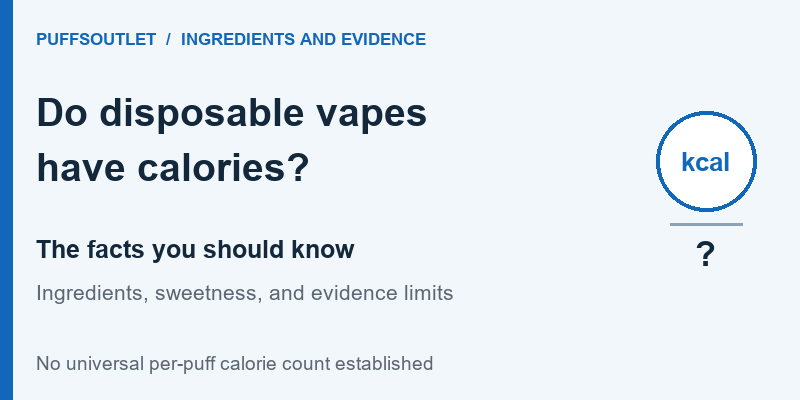
Disposable vape liquid can contain ingredients the body can metabolize, so an absolute claim that vaping delivers zero calories is not well supported. However, the evidence reviewed here does not establish a reliable calorie count per puff, per device, or per day for disposable vapes.
The useful distinction is between the energy associated with a liquid ingredient and the energy a person actually obtains after inhaling its aerosol. A sweet flavor, nicotine percentage, or advertised puff count cannot tell you that second amount. This article explains what the research supports and how to assess calorie claims without treating a vape as food, a weight-control aid, or permission to vape during a medical fast.
What is in disposable vape liquid
Le FDA explains how e-cigarettes work: they heat liquid to create an inhaled aerosol. That liquid commonly contains propylene glycol, vegetable glycerin, flavorings, and nicotine. Formulations differ, and some products are marketed without nicotine.
Vegetable glycerin, often abbreviated VG, is also called glycerol. Propylene glycol is commonly shortened to PG. These carrier ingredients help explain why asking only whether a flavor contains sugar misses part of the question.
Le National Academies review of e-cigarette constituents describes glycerol metabolism, including pathways that can produce glucose, and the metabolism of propylene glycol. These ingredients are not biologically inert simply because exposure occurs through vaping. But information about oral metabolism does not establish the calorie yield of inhaling a particular disposable product.
| Label or ingredient | What it describes | What it cannot establish |
| VG or glycerol | A carrier that the body can metabolize | Calories obtained from each puff |
| PG | Another commonly used carrier | A universal daily energy intake |
| Nicotine strength | Nicotine concentration in the liquid | Sugar content or a calorie count |
| Flavor name | The marketed flavor experience | A complete ingredient analysis |
Inhaling does not mean nothing enters the body
A common online explanation says that vapes have no calories because you inhale rather than eat them. That reasoning overlooks absorption and retention of aerosol constituents.
In a human study of nicotine and carrier retention, 13 experienced adult e-cigarette users took 15 puffs from their usual devices. Researchers measured constituents delivered and exhaled and found substantial retention of PG and VG. This was an exposure study, not a trial measuring calories or weight gain, and it did not establish results for every modern disposable.
Retention also does not mean that every retained molecule becomes usable energy. The study challenges the claim that everything is simply breathed out; it does not provide a dietary conversion factor.
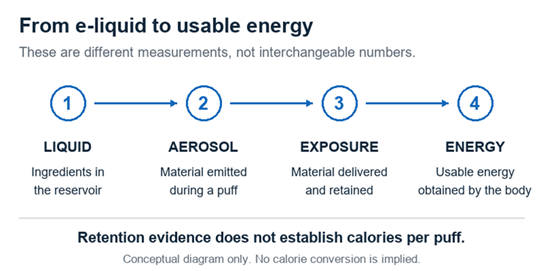
Ingredient composition, aerosol delivery, retention, and usable energy are separate questions. This diagram does not provide a calorie conversion.
Why there is no dependable calorie count per puff
For packaged food, calories describe energy obtained from a serving. The FDA guide to calories on food labels emphasizes both the energy value and the serving size. Applying food-style arithmetic to a vape requires additional evidence that a liquid volume or puff label does not provide.
An estimate might multiply the stated liquid volume by an assumed energy value and divide the result by the advertised puff count. This can look precise while leaving several questions unanswered:
- Does the calculation use the actual formulation or an assumed PG and VG ratio?
- Is the liquid quantity expressed as mass or volume, and is the conversion justified?
- Does the advertised puff count represent the person’s puff duration and device settings?
- Is the number an estimate for the liquid in the reservoir or measured energy obtained by the user?
These questions are a way to audit a claim, not a validated calculator. Without a defensible link between the inputs and the outcome, adding decimal places does not improve the answer.
For the separate question of how advertised puffs relate to everyday use, see how long a disposable vape should last. A lifespan estimate should not be reused as a calorie conversion.
The same limitation applies to daily totals. Someone else’s puff count is not a measured serving size for your device. The sources reviewed here do not justify a universal claim such as a fixed number of calories for every hundred puffs.
Sweet flavors do not reveal sugar or calories
A flavor described as strawberry, candy, or dessert does not tell you how much sugar is present. Sensory sweetness and nutritional composition are different measurements.
In research on sucralose and perceived e-cigarette sweetness, the effect of added sucralose varied between the tested delivery systems. That finding helps explain why the taste alone cannot identify the formulation or support a calorie estimate. It does not prove that every sweet disposable contains sucralose, or that every product is sugar-free.
Food comparisons can also hide a safety issue. A laboratory study of sucralose-containing e-liquids found that sucralose affected chemical degradation during vaping. The study does not establish an individual user’s risk from a specific disposable, but it illustrates why a sweetener’s use in food is insufficient evidence about heating and inhaling it.
Look for product-specific ingredient information if composition matters to you. A flavor description or a generic statement about sweeteners cannot substitute for it. Even an ingredient list would not, by itself, establish absorbed calories per puff.
Vaping and body weight involve more than calories
There is no sound basis in these sources for predicting weight gain from the flavor of a disposable vape. They also do not support advertising vaping as a way to lose weight or replace snacks.
Nicotine-related appetite changes are a separate issue. Smokefree.gov’s guidance on quitting vaping identifies feeling hungrier than normal as a possible withdrawal symptom. If appetite changes after stopping nicotine, that does not prove the previous vape was providing a particular number of calories.
If concern about appetite or weight makes quitting difficult, discuss it with a health professional who can help with both concerns. Starting or continuing nicotine use to control hunger creates a different problem from checking the energy content of food.
Calorie claims do not decide whether vaping breaks a fast
People use the word fasting for different purposes. A personal eating schedule, a religious observance, preparation for a blood test, and preparation for a procedure do not necessarily follow the same rules. A calorie claim cannot settle all of them.
For a medical example, East Kent Hospitals NHS guidance for fasting blood tests explicitly includes vaping among activities to avoid on the morning of the test. Follow the instructions supplied for your own appointment and ask the team if vaping is not addressed. If you have already vaped, tell them rather than assuming a claimed zero-calorie product cannot matter.
For religious fasting, ask an appropriate religious authority about the observance. For a personal dietary plan, define its purpose rather than treating an unverified calorie number as proof that vaping has no physiological effect. This article cannot establish that vaping preserves ketosis or autophagy.
Sugar and nicotine raise different diabetes questions
A sugar-free claim is not a diabetes safety assessment. CDC guidance on diabetes and smoking states that nicotine raises blood sugar. That point is relevant when considering nicotine exposure, even though the page’s smoking statistics should not be transferred directly to vaping.
If you have diabetes, discuss nicotine use and any changes in your glucose readings with your clinician. Do not adjust medication, insulin, or carbohydrate counting using an online vape-calorie estimate.
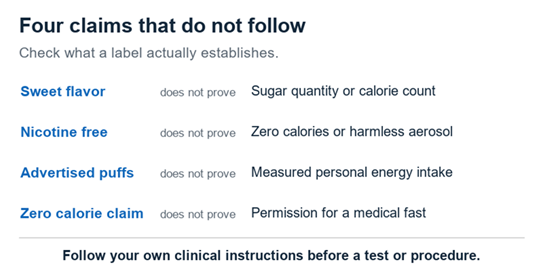
A label can describe one feature without answering a different nutrition or clinical question.
How to assess a vape calorie claim
Use four checks before trusting a number or a zero-calorie promise:
- Identify the claim. Is it about the liquid, a machine-generated aerosol, a person’s exposure, or energy actually obtained by the body?
- Ask for the evidence. Look for the exact product, measurement method, units, and study outcome. An absorption study is not automatically a calorie study.
- Check the proposed use. A claim about ingredients does not establish suitability for a medical fast, diabetes management, or weight loss.
- Keep device information separate. Puff labels and remaining-liquid indicators describe other aspects of use. They are not nutrition measurements.
If your concern is whether the reservoir is nearly depleted, use the separate guide to signs a disposable vape is almost empty. Those observations cannot measure energy intake.
Never taste or swallow e-liquid to investigate its sweetness or composition. The FDA warns that nicotine-containing liquid can be poisonous if swallowed.
Finally, an unknown calorie contribution is not evidence of safety. The CDC overview of vaping health effects explains that aerosol can contain harmful substances and that nicotine is addictive. Choosing a product by a low-calorie claim overlooks those exposures.
Foire aux questions
Do nicotine free disposable vapes have zero calories
Removing nicotine does not remove PG, VG, or all other ingredients. A nicotine-free label therefore does not establish zero absorbed calories. It also does not establish that inhaling the aerosol is harmless.
Does a sweeter vape contain more calories
Taste cannot provide that comparison. Sweetness depends on the formulation and delivery system, and a sweetener may create a strong sensation without revealing the total composition. Product-specific evidence is needed.
Can I enter a disposable vape into a calorie tracking app
An app entry is not a validated measurement. The reviewed evidence does not provide a dependable figure to enter for each puff or device. For a medically supervised nutrition plan, ask the clinician or dietitian how to handle the uncertainty.
Can a larger disposable be assigned more calories
More stated liquid is information about the reservoir, not measured energy absorbed by its user. Comparing device sizes does not resolve differences in composition, delivery, or use. Avoid presenting a reservoir calculation as personal intake.
Will vaping help me eat less
Do not use vaping as an appetite-management strategy. Nicotine can create dependence, and appetite changes around nicotine withdrawal are a separate issue from liquid calories. Seek support if hunger or weight concerns are making it difficult to quit.
Can I vape before a fasting blood test
Follow your appointment instructions. The cited NHS hospital guidance explicitly says to avoid vaping that morning. If you have already used a vape, tell the clinical team so they can advise on the test.
Does sugar free mean suitable for someone with diabetes
No. Sugar content does not describe nicotine exposure or its effect on blood glucose. Discuss nicotine use with your diabetes clinician and avoid making treatment decisions from a flavor name or calorie claim.
Sources et informations complémentaires
Sources checked October 16, 2026. Public health guidance is identified by its issuing organization; the cited experimental studies have narrower findings than a universal calorie assessment of disposable vapes.
- FDA overview of e-cigarettes and their ingredients — liquid constituents and aerosol generation.
- National Academies review of e-cigarette constituents — carrier chemistry and metabolism; not a per-puff calorie study.
- Nicotine delivery retention and pharmacokinetics from various electronic cigarettes — human exposure research involving 13 experienced adult users.
- FDA explanation of calories on food labels — dietary energy and serving sizes.
- Sucralose and flavor sweetness across delivery devices — experimental sensory findings.
- Sucralose enhanced degradation during vaping — laboratory chemistry findings.
- Smokefree.gov nicotine withdrawal and vaping — appetite changes and quitting support.
- East Kent Hospitals NHS fasting blood test instructions — appointment preparation including vaping.
- CDC diabetes and smoking guidance — nicotine and blood glucose; smoking risk estimates are not vaping estimates.
- FDA advice on accidental e-liquid exposure — swallowing and contact hazards.
- Effets du vapotage sur la santé selon le CDC — aerosol exposure and nicotine addiction.
 Vaporisateurs de 9 000 bouffées
 Vaporisateurs de 12 000 bouffées
 Vaporisateurs de 15 000 bouffées
 Vaporisateurs de 20 000 bouffées
 Vaporisateurs de 30 000 bouffées
 Vaporisateurs de 40 000 bouffées
 Vaporisateurs de 50 000 bouffées
 Vaporisateurs de 60 000 bouffées
 Vaporisateurs de 80 000 bouffées
 Vaporisateurs de 100 000 bouffées