







Blog
Rechargeable vs Non Rechargeable Disposable Vapes

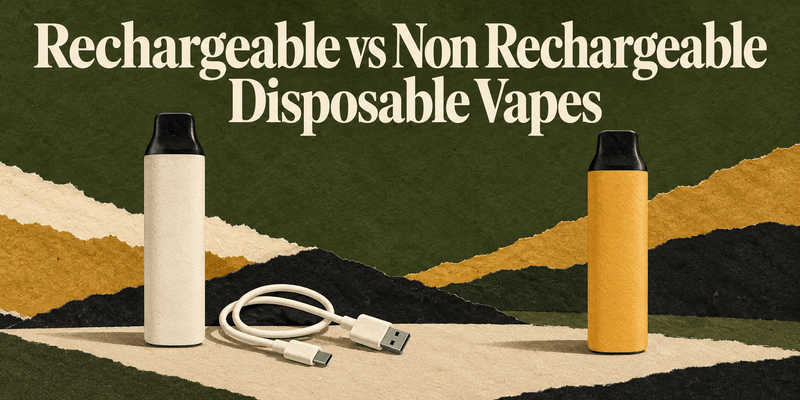
A rechargeable disposable vape permits external battery charging under its model instructions while its original usable liquid remains. A non-rechargeable disposable does not provide a permitted recharge operation. Both can still be single-use devices with no refillable reservoir or user-replaceable parts. Charging, refilling and replacing a pod are separate capabilities.
For adults identifying equipment they already own, compare those capabilities before following a charging tutorial. A port, a screen, battery chemistry or a large puff claim cannot establish all of them. The exact model and version determine what the user is allowed to do and when the complete device has reached its endpoint.
Three capabilities define the comparison
CDC distinguishes disposable, refillable and prefilled cartridge or pod devices. Its description notes that disposables may recharge but are not designed for refilling. This explains why rechargeable and disposable are not automatically contradictory descriptions.
Recharging supplies electrical energy to the intended battery system. Refilling adds liquid through a user filling system that the manufacturer actually provides. Replacing a prefilled pod changes a consumable while retaining a compatible device body. None of those operations establishes permission for the other two.
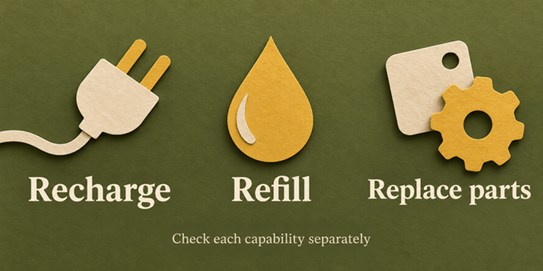
Check each capability in the actual instructions. The illustration does not authorize all three operations on one device.
A sealed rechargeable disposable can therefore accept power repeatedly during the life of its original liquid supply while remaining non-refillable. A reusable body with replaceable prefilled pods is a different arrangement, even if the discarded pod is itself single-use. Read which component a product description is discussing.
Do not interpret these categories as a map for disassembly. A battery, reservoir or heater being present does not make it accessible. The comparison concerns intended user operations, not what an online teardown can physically expose.
What the manufacturer examples actually show
For a named non-rechargeable example, Vuse’s Belgium FAQ describes its Vuse Go as a single-use device with a non-replaceable lithium-ion polymer battery and says it is not rechargeable. The useful detail is that the device’s permitted operation comes from the actual product instructions, rather than an inference from battery chemistry.
For a contrasting example, ELFBAR’s support page describes BC10000 as single-use but rechargeable when the battery is depleted and e-liquid remains. It says the device should be disposed of once that liquid is exhausted. This is a rechargeable disposable, rather than a refillable system created by the presence of a charging connection.
These descriptions apply to the named products in those sources. They are not statements that every Vuse Go version is identical, every ELFBAR recharges, or either product is currently available or authorized in your location. Similar names can identify different generations or device types.
For your own item, match the full model, version and market designation with its documentation. If a leaflet describes a different body or control layout, ask the manufacturer to resolve the mismatch instead of borrowing a charging direction from a familiar name.
Compare the tasks and limits
The practical difference is the set of supported tasks. A rechargeable design adds a charging connection, suitable supply and completion signal to understand. A non-rechargeable design has no such user charging task. Both still require attention to liquid depletion, damage and the manufacturer’s end-of-use directions.
| Question | Rechargeable disposable | Non rechargeable disposable |
| Can battery energy be replenished | Through its intended charging system and instructions | No permitted external charging operation |
| Can more liquid be added | Charging alone does not establish refillability | Non rechargeability does not establish refillability |
| Does a normal low battery signal end use | May permit charging if liquid remains and condition allows | Follow the model’s end-of-use guidance |
| Are internal parts user replaceable | Only if exact instructions expressly provide it | No permission follows from this classification |
| Does the complete device need appropriate collection | Yes when retired | Yes when retired |
The words in the table do not establish a universal winner. A device offering charging has an additional supported operation; that does not prove greater reliability, better flavor or lower health risk. A model without charging does not become suitable for an improvised power connection merely because the battery runs down first.
Compare specifications only for the task they describe. A battery capacity, liquid volume or advertised puff count is not a substitute for a clear rechargeable specification. Nor does a longer-looking feature list establish a longer observed life under different use conditions.
Why a charging cycle does not reset the whole device
A rechargeable disposable has separate electrical and liquid limits. Battery energy may be replenished, but liquid used during operation is not restored by charging. The BC10000 description above illustrates that distinction directly: charging is conditional on liquid still remaining, and liquid exhaustion is the stated retirement point.
This means one charge is not the whole life of every rechargeable disposable. It also means another charge cannot promise another complete printed puff count. The number of permitted charging sessions, indicator behavior and normal endpoint depend on the actual product. Do not invent a universal recharge count from a battery label.
Read the battery and liquid indications separately where the manufacturer provides them. A full battery display does not establish remaining liquid, heater condition or permission to continue through a persistent burnt taste. An unfamiliar light is an observation to interpret using the manual, rather than proof of one particular fault.
Our explanation of how long a disposable vape should last addresses elapsed use and puff claims as a separate question. A design label alone cannot convert into days, and an estimate should never override an actual stop-use condition.
If the device leaks, becomes damaged or behaves abnormally, stop routine use and seek model-specific support. Do not connect it to power to determine whether the problem goes away. A charging capability is intended for normal operation, not a general repair method.
Confirm the charging design without improvising
Look for an explicit rechargeable specification and the matching instructions, not just an opening near the base. A port shape identifies a connection type only after the manufacturer has identified its purpose. A capacity or battery-chemistry description cannot supply a missing charger requirement.
FDA advises reading the manufacturer’s use and care directions and contacting it if instructions are missing or unclear. For an intact rechargeable model, those directions should identify the charging equipment, permitted input and completion indication.
Notre guide to charging a disposable vape explains the actual charging checks. Keep that operational task separate from this design comparison. Do not assume that a higher-rated phone adapter charges every vape faster or that one brand’s full-charge light applies to another model.
FDA also recommends a visible clean, flat charging surface away from material that can catch fire, and protection from extreme temperatures. Charging requires appropriate conditions as well as a compatible connector. A feature description does not remove those care requirements.
For a non-rechargeable model, or an unidentified item without charging directions, do not open the casing, strip a cable or attach wires to the internal battery. Ask for clarification or follow the appropriate retirement route. Physical access to a cell is not evidence that the device supports charging.
Both designs need a whole device end of use plan
Rechargeability does not turn a finished sealed disposable into ordinary packaging. The US EPA advises households to use appropriate household hazardous waste collection for e-cigarettes and keep them out of household trash and ordinary recycling. Its explanation identifies lithium batteries and nicotine as waste-management hazards.

Confirm whole-device acceptance and condition with the receiving operator. This illustrative scene is not packing or transport instructions.
Confirm that the receiving operator accepts the complete device and ask about its actual condition before taking it there. Other countries and business waste need their own arrangements. Our US disposable-vape collection guide sets out the questions to ask without treating every battery bin as suitable for a whole vape.
Keep a sealed device assembled. Do not extract the battery, drain residual liquid or repeatedly activate it to make it empty before disposal. Apparent depletion does not establish that the electrical or chemical hazards have disappeared.
The rechargeable label also does not establish an overall environmental advantage by itself. That comparison would require evidence about the complete products, use and treatment routes. What both owners can establish now is the actual device type, its intended endpoint and a collection route that accepts it.
Foire aux questions
How can a disposable also be rechargeable
Disposable can describe the complete product being retired after its original liquid supply is finished. Rechargeable describes an electrical operation available before that endpoint. It does not make the sealed liquid system refillable.
Does lithium ion mean the device can recharge
Not by itself. The Vuse Go FAQ example identifies lithium-ion polymer chemistry while expressly prohibiting a user recharge operation. Use the exact device instructions rather than battery chemistry as permission.
Can I charge a model with no charging port
Do not create a connection by opening it or modifying a cable. If the documentation does not establish an intended charging method, ask the manufacturer and follow its guidance for the product’s endpoint.
Does a screen mean I can refill the device
No. A display reports the functions assigned by the manufacturer. It does not establish a filling system, removable reservoir or permission to add liquid.
Will a rechargeable disposable always deliver more puffs
The category alone cannot establish that. Liquid capacity, device design, mode, rating method and actual use would need comparison. Recharging does not reset the original liquid supply or guarantee the printed count.
Can either type go in ordinary recycling when finished
For US households, EPA says to keep e-cigarettes out of household trash and ordinary recycling and use the appropriate collection route. Elsewhere, confirm local arrangements and the operator’s acceptance of the complete item.
Sources et informations complémentaires
Source check date: October 28, 2026. Manufacturer examples describe named designs, not current local stock or product authorization. Disposal guidance specifically identified as EPA guidance applies to US households. No comparative runtime or lifecycle test was performed.
- CDC overview of disposable, refillable and prefilled-pod device types.
- Vuse Belgium FAQ describing its non-rechargeable Vuse Go; named design only.
- ELFBAR support explanation of BC10000 rechargeability and liquid exhaustion.
- Recommandations de la FDA concernant l'utilisation et l'entretien des batteries de cigarettes électroniques.
- EPA e-cigarette disposal information for individuals, mise à jour le 30 janvier 2026.
 Vaporisateurs de 9 000 bouffées
 Vaporisateurs de 12 000 bouffées
 Vaporisateurs de 15 000 bouffées
 Vaporisateurs de 20 000 bouffées
 Vaporisateurs de 30 000 bouffées
 Vaporisateurs de 40 000 bouffées
 Vaporisateurs de 50 000 bouffées
 Vaporisateurs de 60 000 bouffées
 Vaporisateurs de 80 000 bouffées
 Vaporisateurs de 100 000 bouffées
Une pensée sur « Rechargeable vs Non Rechargeable Disposable Vapes »