







Blog
Vaporisateurs jetables ou rechargeables : entretien et limites des appareils

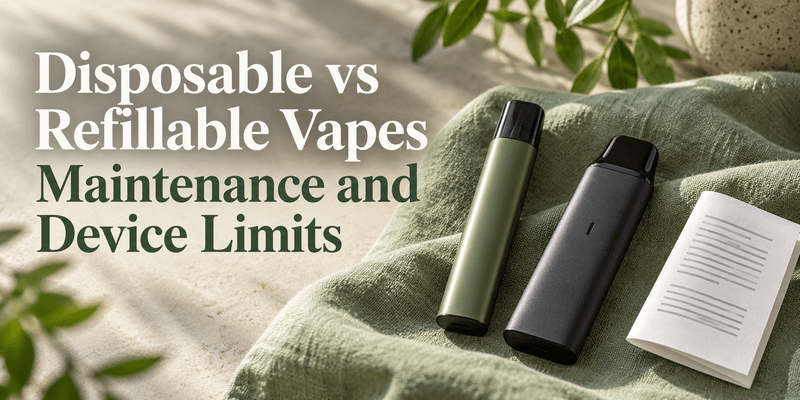
Disposable and refillable vapes differ in which maintenance tasks their designs permit. A sealed disposable usually limits the owner to documented exterior care and charging where supported. A refillable device adds a filling task; it may also allow replacement of a whole pod or a separate coil. Each permission needs confirmation in the exact model instructions.
For adults maintaining an existing device, the useful question is which part the manufacturer expects you to service. A charging socket, detachable mouthpiece or similar appearance cannot answer that question alone. Identify the device and its intended consumables before choosing a cleaning or replacement method.
Establish three separate permissions
Rechargeability concerns battery energy. Refillability concerns adding liquid through an intended filling system. Replaceability concerns exchanging a component the manufacturer identifies as removable. These capabilities can occur in different combinations.
ELFBAR support describes BC10000 as rechargeable while explaining that charging cannot restore depleted liquid. That named example shows why a charging operation does not establish permission to open or refill a sealed reservoir. It does not establish the design of every ELFBAR model.

Charging, filling and replacement each require their own model-specific permission.
A refillable pod may have its coil built into the pod. In that design, replacing the consumable can mean replacing the complete pod. Another product may allow a separate coil replacement. Use the model’s parts list to distinguish these tasks instead of assuming that refillable means every part can be removed.
Notre rechargeable versus non rechargeable disposable comparison explains the electrical distinction. Here, the maintenance decision continues beyond charging to the liquid system and serviceable unit.
Match cleaning to the actual component
Exterior cleaning and cleaning a removable non-electronic part are different operations. A method suitable for an empty removable tank does not automatically apply to a complete device containing a battery and electronics.
Innokin’s atomiser cleaning article excludes the coil from its rinse step and requires air drying. This is guidance for the serviceable atomiser context it describes. It is not permission to dismantle or wash a sealed disposable, immerse a battery section, or rinse every modern pod design.
The lesson is to establish the component boundary before selecting the cleaning method. If the manual identifies a removable washable component, follow that component’s directions, including drying and reassembly requirements. If it does not, ask the manufacturer instead of borrowing a procedure from another product.
Notre disposable exterior cleaning guide addresses the narrower sealed-device task. Cleaning the outside cannot replace missing liquid, repair internal damage or establish that an unidentified component is serviceable.
Compare the recurring maintenance tasks
The table describes permissions to check, rather than instructions for opening a particular device. A product can fit more than one category, so keep the actual model alongside the category name.
| Task | Sealed disposable | Refillable design |
| Exterior care | Follow permitted external care | Follow permitted external care |
| Recharge | Only when expressly supported | Confirm the actual charging system |
| Adding liquid | Do not infer a refill permission | Use only the intended filling system |
| Replacing a consumable | Do not open a sealed housing | Identify whole pod or separate coil |
| Washing parts | No whole-device immersion | Only parts identified as washable |
Extra maintenance tasks require information as well as time. A refillable owner needs to identify the compatible liquid and consumable, the filling limit and any preparation requirement. A disposable owner still needs correct care and an end-of-use plan. Neither category is maintenance-free in the sense of being suitable for use regardless of its condition.

Identify the model and permitted care before attempting maintenance. Illustrative scene only.
Before buying replacement parts for an existing device, match the complete part designation. A similar size or a shared brand name does not prove compatibility. If the actual consumable is unavailable or cannot be identified, that information gap needs resolution before attempting a substitute.
Distinguish normal upkeep from a fault
Refilling addresses an intended liquid-supply task. Replacing a documented consumable addresses the component the manufacturer expects to wear. Cleaning addresses the contamination or residue covered by the permitted method. None of these operations is a general repair for every loss of flavor or output.
A persistent burnt taste is not a reason to keep using a device while trying repeated cleaning experiments. In a serviceable design, consult the actual replacement and troubleshooting directions. In a sealed disposable, the presence of liquid or battery charge does not create a coil-replacement operation.
Stop ordinary use and charging when the device is damaged, leaking or unusually hot. Describe that condition to manufacturer support. A routine care checklist should not conceal a fault, and a favorable appearance after wiping does not establish internal condition.
Build a maintenance plan from the manual
Keep the exact model name, consumable designation and current instructions together. List only the tasks those instructions permit. Record a replacement or problem when it actually occurs, rather than inventing a fixed weekly schedule for every liquid and device combination.
For a refillable product, distinguish the instruction for the liquid container from the instructions for the device. FDA advises keeping e-liquids in their original containers, securing caps and storing products out of children’s and pets’ reach and view. Those handling requirements remain relevant even when the device itself is simple to fill.
If directions are missing, ask a precise question: is this component intended to be removed, washed, filled or replaced by the user? Our guide to actual model instructions explains why controls and procedures should not be borrowed from a similar-looking product.
Decide by permitted tasks and stopping points
A useful comparison identifies the work involved, the parts that can be replaced and the conditions that end routine use. It does not require a universal claim that one category is cheaper, safer or more sustainable. Those conclusions need their own evidence and actual products.
When a sealed device reaches its endpoint, keep it intact and confirm an appropriate receiving route for the complete item. When a refillable device needs an identified replacement, use the documented part and procedure. If the problem concerns the battery or unknown internal damage, routine consumable maintenance is not enough to resolve it.
Foire aux questions
Does rechargeable mean refillable
No. Battery charging and adding liquid are separate permissions. Check the actual model’s intended liquid system.
Can I clean inside a sealed disposable
Do not open a sealed housing for routine cleaning. Follow permitted exterior care and contact the manufacturer about inaccessible contamination or damage.
Does every refillable pod have a replaceable coil
No. The serviceable unit may be the whole pod. Match the manufacturer’s part designation before ordering or attempting removal.
Can I rinse the whole device
Do not transfer a removable tank’s washing directions to a complete electronic device. Only clean components by the method their instructions permit.
How often should maintenance happen
Use the model’s directions and actual condition. A universal number of days cannot account for every design, consumable and use pattern.
Can cleaning make a damaged vape usable again
Exterior cleaning does not establish that internal damage is repaired. Stop routine use and charging and seek condition-specific support.
Sources et informations complémentaires
Source check date: October 30, 2026. Manufacturer examples are limited to the products and component contexts described. No product was dismantled, tested or independently certified.
 Vaporisateurs de 9 000 bouffées
 Vaporisateurs de 12 000 bouffées
 Vaporisateurs de 15 000 bouffées
 Vaporisateurs de 20 000 bouffées
 Vaporisateurs de 30 000 bouffées
 Vaporisateurs de 40 000 bouffées
 Vaporisateurs de 50 000 bouffées
 Vaporisateurs de 60 000 bouffées
 Vaporisateurs de 80 000 bouffées
 Vaporisateurs de 100 000 bouffées