



Blog
Are Disposable Vapes Banned

Yes, disposable vapes are banned from sale or supply in several countries, but there is no single worldwide rule. The UK ban has applied since June 1, 2025. The United States instead requires attention to specific FDA product authorizations and state or local restrictions. Some jurisdictions also prohibit possession and use, while others focus on commercial activity.
This overview was checked on October 15, 2026. It covers selected jurisdictions, not every country or every local rule; cannabis-product laws are outside its scope. Before relying on a headline that says “vapes are banned,” establish the location, the device definition, the activity being restricted, and the effective date. A law that has been signed may contain a sales prohibition that starts later.
Where Disposable Vape Restrictions Apply
The table summarizes the main distinction in each location. Follow the linked official sources and the explanations below for scope. The United States row describes the federal position; California is a separate state example.
| Location | Main restriction or regulatory approach | Relevant date or distinction |
| United Kingdom | Business sale and supply of single-use vapes prohibited | In force June 1, 2025; includes nicotine-free devices |
| United States | FDA authorization for the specific product; state and local restrictions also matter | No equivalent single nationwide disposable-category ban date |
| California | AB 762 introduces a future disposable nicotine vape retail prohibition | Retail restriction starts January 1, 2028; other rules already apply |
| Australia | Domestic manufacture, supply and commercial possession of disposable single-use vapes prohibited | July 1, 2024; current lawful consumer supply is through pharmacies |
| France | Sale, distribution and free supply of covered non-refillable devices prohibited | In force February 26, 2025; rechargeable batteries do not exempt them |
| Belgium | Disposable e-cigarettes prohibited from the market | January 1, 2025; with or without nicotine |
| New Zealand | Sale, offer for sale, manufacture, supply and distribution restricted | Ban took effect June 17, 2025 |
| Singapore | Broader vaporiser prohibitions include purchase, possession, use, import and supply | Not limited to disposable designs |
Do not read a sale restriction as a complete statement of personal possession law. Equally, an exception concerning possession does not establish permission to import a product or sell it to someone else.
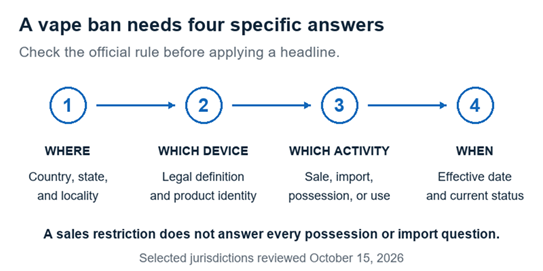
Read the location, device definition, restricted activity, and effective date together.
United Kingdom Ban on Business Sale and Supply
The UK government’s current guidance says businesses cannot sell, supply, offer to sell or supply, or stock single-use vapes intended for sale or supply. It covers online and shop sales and devices with or without nicotine. The ban applies across the UK, although enforcement arrangements differ between its four nations.
The important distinction is product design. A battery that can be recharged does not, by itself, make the entire device reusable. A sealed liquid supply can still put a rechargeable product within the single-use definition.
The English regulations defining single-use vapes address recharging, refilling, and replacement coils. A refill can involve a user-refillable container or a separately available replacement container. Where a coil is used, it must be replaceable as required, including through a separately available replacement pod or cartridge.
Our explanation of how charging a disposable vape works distinguishes battery energy from liquid supply. That physical distinction helps explain why a charging port cannot establish legal classification. Do not try to make a sealed device compliant by dismantling it; use the intended design and applicable definition.
United States Product Authorization and Local Restrictions
The U.S. position should not be reduced to either “all disposables are legal” or “every disposable has been banned nationally.” FDA has issued marketing authorizations for specific disposable products. Its current authorized e-cigarette list provides the up-to-date product reference.
FDA’s enforcement guidance states that only authorized e-cigarettes may currently be lawfully sold in the United States. A pending application does not create a general legal safe harbor. The same guidance identifies limited circumstances involving further review or stays where FDA does not intend enforcement; this is not blanket permission for unauthorized products.
Check the exact product identity, not just a brand name, a seller’s “compliant” label, or whether a store carries it. Authorization of one product does not authorize an entire brand’s range. FDA also states that marketing authorization does not mean a product is safe or “FDA approved.”
State rules add another layer. The California Department of Public Health describes a retail prohibition on most flavored tobacco products, including flavored e-cigarettes. A device can therefore raise both product-authorization and flavor-law questions. Other states and localities require their own checks.
California Has a Future Retail Ban Date
California’s new disposable-device law illustrates why dates matter. The official AB 762 signing announcement, dated September 28, 2026, states that from January 1, 2028, retailers will not be able to sell nicotine vapes unless they are rechargeable and refillable.
On this article’s October 15, 2026 check date, that retail prohibition is a future requirement. This does not suspend existing FDA requirements, California’s flavor restrictions, or other applicable rules. A future deadline must not be presented as permission to sell a product that is already unlawful under a different provision.
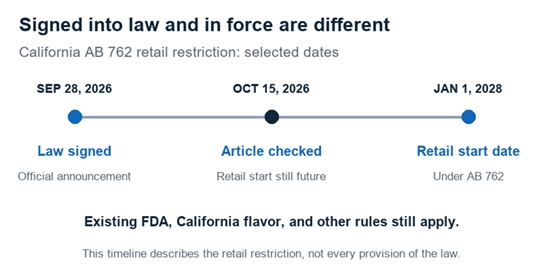
California example: a law can be signed before its retail prohibition begins. Existing restrictions still apply.
Australia Regulates Supply and Personal Possession Differently
The TGA’s July 2024 reform announcement states that domestic manufacture, supply and commercial possession of non-therapeutic and disposable single-use vapes became unlawful on July 1, 2024. Older articles describing a period when pre-existing retail stock could still be sold should not be treated as current guidance.
The TGA’s current compliance and enforcement page says consumer supply is through pharmacies, subject to the therapeutic framework, and that personal importation is no longer allowed. It also states that Australia’s vape laws do not criminalize possession by individuals genuinely holding vaping goods for personal use.
That distinction does not make overseas ordering, commercial supply, or every product lawful. Check current TGA information and relevant state or territory requirements for the activity involved, rather than treating a personal-possession statement as an import exemption.
France Belgium and New Zealand Have Their Own Definitions
France
France’s official public-service guidance dates its restriction to February 26, 2025. It covers offering, selling, distributing, free supply, and holding covered products for those purposes. The relevant devices are prefilled and cannot be refilled, whether or not the battery can recharge. This is another example of recharging and refilling being different legal questions.
Belgium
Belgium’s federal health announcement states that its market prohibition for disposable e-cigarettes took effect on January 1, 2025 and covers devices with or without nicotine. This is a Belgian rule; it should not be presented as a single EU-wide disposable ban.
New Zealand
New Zealand’s Ministry of Health confirmed a June 17, 2025 commencement date. Its device guidance distinguishes products not designed for recharging or user refilling from reusable designs, including those refilled by replacing a pod. The restricted commercial activities include sale, manufacture, supply and distribution. A reusable product still has to meet other applicable requirements.
Singapore Prohibits More Than Disposable Vape Sales
Singapore is a clear example of why possession needs a separate answer. HSA’s current enforcement guidance says purchase, possession and use of vaporisers have been prohibited since February 1, 2018, alongside earlier importation, sale and distribution prohibitions. The framework was strengthened and renamed under the Tobacco and Vaporisers Control Act from May 1, 2026.
Do not assume that an existing device, a rechargeable design, or personal-use intent removes these prohibitions. The relevant rule is broader than a retail ban on disposable products.
What to Check Before Travel or Relying on a Listing
Start with the destination’s health regulator and customs authority. Check transit locations too, because carrying a product across a border raises a different question from owning it at home. Airline baggage permission does not establish permission to import, possess or use it at the destination.
Our guide to disposable vapes on an airplane covers the separate transport checks. Do not use an airline’s acceptance of an item as a substitute for destination law.
For an online listing, verify the destination and exact device definition against official guidance. An available checkout, an adult age check, or a claim that the product is nicotine-free does not establish legality. Keep the source, its scope, and the effective date together when assessing any claim.
When a device needs disposal, follow local collection instructions. In the United States, the EPA recommends household hazardous waste collection for e-cigarettes, not household trash or ordinary recycling. A prohibition does not make putting a lithium-battery device in general waste appropriate.
Frequently Asked Questions
Are disposable vapes banned everywhere
No single worldwide rule applies. Some places prohibit single-use sales, others regulate specific products, and some also prohibit possession and use. Check the country, any state or local rules, and the activity involved.
Are nicotine free disposable vapes exempt
Not necessarily. The UK and Belgium restrictions expressly cover disposable devices with or without nicotine. A zero-nicotine label alone is not evidence that a device is exempt from a design-based ban.
Does a USB charging port make a vape reusable
No. Recharging and refilling are separate features. Applicable definitions can also require replaceable components. Use the product’s intended design and the jurisdiction’s rules, rather than the presence of a port.
Can I keep a device I already own
The answer depends on possession rules, not just sale rules. Australia’s TGA distinguishes genuine personal possession from commercial activity, while Singapore prohibits possession. Check the relevant authority before drawing a conclusion about an existing device.
Is California already banning every disposable vape sale
AB 762’s new retail restriction starts January 1, 2028, according to the signing announcement. That date was still in the future when this article was checked. Existing federal, state and local restrictions continue to matter in the meantime.
Does an FDA application mean a disposable can be sold
A pending application is not marketing authorization or a general safe harbor. FDA describes limited enforcement situations separately. Verify the specific product against current FDA information and check applicable state and local restrictions too.
Can I order from another country if shops cannot sell it locally
An overseas seller’s willingness to ship does not override destination law. Import restrictions require a separate check, including any personal-import rules. Do not assume a website listing or courier option establishes permission to receive the product.
Sources and Further Information
Official sources checked October 15, 2026. This is a selected-jurisdiction overview; rules, enforcement arrangements, and future commencement dates should be rechecked before publication or reliance.
- GOV.UK — Single Use Vapes Ban Guidance.
- England Regulations — Definition of a Single Use Vape.
- FDA — Unauthorized Tobacco Product Enforcement.
- FDA — Current Authorized E Cigarette List.
- FDA — Specific Disposable Product Marketing Decisions, June 10, 2022; read with the current list.
- Assemblymember Jacqui Irwin — AB 762 Signing Announcement, September 28, 2026.
- California Department of Public Health — Flavored Tobacco Sales Law.
- TGA — July 2024 Vaping Reforms.
- TGA — Current Compliance and Enforcement Guidance.
- France Service Public — Disposable E Cigarette Prohibition, French official source.
- Belgian Federal Government — Disposable E Cigarette Prohibition, French official source.
- New Zealand Ministry of Health — Disposable Device Rules.
- New Zealand Ministry of Health — June 2025 Commencement Reminder.
- Singapore HSA — Current Vaping Enforcement.
- EPA — How to Safely Dispose of E Cigarettes.
 9000 Puff Vapes
 12000 Puff Vapes
 15000 Puff Vapes
 20000 Puff Vapes
 30000 Puff Vapes
 40000 Puff Vapes
 50000 Puff Vapes
 60000 Puff Vapes
 80000 Puff Vapes
 100000 Puff Vapes