







Blog
How E Liquid Viscosity Affects Wicking and Vapor

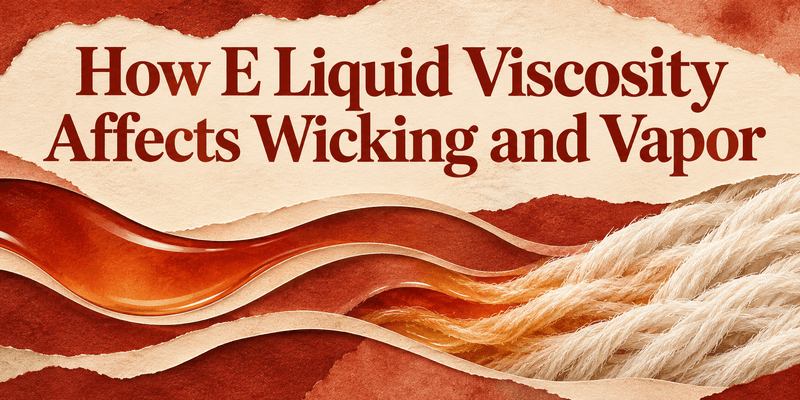
Viscosity describes resistance to flow. In a vape, it matters because liquid must reach the heating area through the intended wick and liquid path. The result depends on the complete liquid and device combination, including its geometry and heating conditions. A thicker liquid does not automatically produce more usable output or suit every coil.
For adults assessing equipment they already own, the practical question is whether the liquid matches the actual consumable’s directions. This explanation connects flow and heating without supplying a mixing recipe, device modification or settings recommendation.
What viscosity changes in the liquid supply
Innokin’s coil-care explanation describes higher-viscosity VG as slower to saturate a coil than lower-viscosity PG. This concerns liquid replenishment. It does not establish a universal saturation time or show that every finished liquid behaves like a pure ingredient.
A PG/VG label can therefore be relevant without being a complete flow specification. Our PG and VG compatibility guide explains those ingredient and ratio fields. Here, the issue is how a formulation reaches a particular heating assembly.
Keep the liquid’s identity alongside the device and consumable names when asking about compatibility. Replacing that information with a description such as thick or watery makes a precise answer harder. Appearance is not a measured viscosity value.
How the wick connects supply and heating
The original capillary-evaporation study by Gao and colleagues describes capillary transport supplying a porous wick during heating. The wick is part of a liquid-delivery system, rather than simply a holder next to the heater.
Capillary action replenishes liquid lost through evaporation. With the same path geometry and driving pressure, higher viscosity increases resistance to that transport. Heating can demand liquid faster than a particular wick can replenish it; more electrical input does not itself increase the supply capacity.
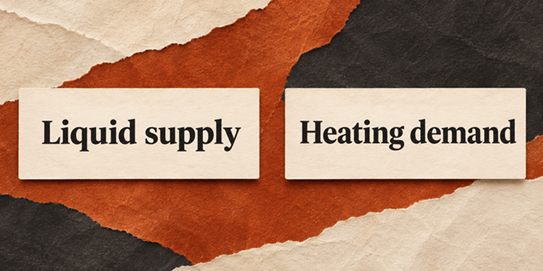
Liquid replenishment and heating demand must be considered together.
This is why a supply explanation must identify the actual path and consumable. A generic illustration of supply and demand can show the relationship, but it cannot establish the internal layout of an unidentified product. A visible reservoir is not an inspection of the wick.
What the numerical research can establish
Il 2021 study modeled a low-power porous wick with an externally wound heater and compared predictions with a scaled bench. In its low-porosity cases, reaching a capillary supply limit meant that further power did not bring a proportional vaporization increase; liquid temperature could rise instead. That is a conditional model result, not a universal threshold or diagnosis.
The model included viscosity in its transport description, while omitting viscosity effects in the heated section. Changing PG/VG composition also changes properties besides viscosity. It was not an isolated trial proving that viscosity alone determines output in every vape.
For a reader interpreting a product claim, the useful lesson is to ask what the comparison held constant. If both the liquid and hardware changed, attributing the entire result to thickness would be an extra conclusion. A model’s defined apparatus and assumptions belong with its findings.
The research does not authorize copying laboratory powers into a different device, altering wick porosity or dismantling a sealed assembly. Those are different tasks from understanding the physical explanation.
Why visible output is a separate comparison
The study’s vaporization rate is a defined research quantity. It should not be substituted for the size of a visible cloud, a personal nicotine measurement or a product-quality score. A claim using the word vapor needs to explain which result was actually measured.
When comparing two reports, first check whether they describe the same quantity under comparable conditions. A statement about faster liquid saturation and a statement about visible output do not necessarily disagree; they may be answering different questions.
Similarly, saying that liquid flows readily does not establish that it is compatible with a particular seal, pod or heater. Avoid using one attractive property to replace the complete equipment requirements. There is no single thickness label that settles every part of the decision.
Geometry and the intended consumable still matter
Innokin distinguishes small wicking ports from larger ones when explaining why high-VG liquids do not suit all its coils. That is manufacturer guidance about component compatibility, not permission to apply one blend rule across all brands and versions.
Il nostro coil types explanation separates heater geometry, resistance and the replaceable assembly. A mesh label does not independently identify the liquid openings or the complete compatible consumable.

Check the actual device and consumable instructions before choosing an operation.
Read the exact device and coil or pod directions together. If they leave a liquid requirement unclear, ask the manufacturer about that combination. Do not enlarge a port, remove wick material or add ingredients to force a match. Identifying a possible flow limitation does not create a suitable modification.
Keep an abnormal observation separate from a diagnosis
A burnt taste, leakage or reduced output is an observation to describe. It does not independently prove that viscosity is the cause. Our guide to a new disposable tasting burnt addresses that narrower product problem and the importance of its timing.
Stop using a concerning item rather than repeatedly activating it to test a viscosity theory. For damage, unusual heat or leakage, seek guidance for the actual condition before continuing ordinary use or charging. Keep sealed equipment assembled.
Do not deliberately heat, chill or dilute liquid as an improvised test. Preserve the product information and the sequence of what you already observed. Useful support starts with those facts, not an unverified diagnosis or a new home experiment.
Domande frequenti
Does thicker liquid always produce more vapor
No universal result follows from thickness alone. The liquid must suit the complete system, and a claim needs to define what output it measured.
Does a mesh coil automatically accept high VG
No. Heater geometry does not identify the whole liquid path or compatibility requirements. Use the actual consumable directions.
Should I warm a cold device to improve flow
Do not invent a heating routine. Follow the product’s storage and operating directions and seek clarification if conditions are outside them.
Can I add water to improve wicking
Do not change a nicotine liquid with household additions to solve an unidentified compatibility problem. Confirm the intended formulation instead.
Do bubbles prove the wick is supplied correctly
A visible observation is not a complete assessment of the internal supply path. It cannot establish the condition of the heating area.
Does a burnt taste prove excessive viscosity
No. Record what happened and stop using the concerning item. Taste alone cannot distinguish every possible cause.
Fonti e ulteriori informazioni
Source check date: November 5, 2026. Numerical research concerns its specified low-power apparatus and assumptions. Innokin statements are manufacturer guidance within their component context. No liquid property or device performance was tested for this article.
Innokin explanation of saturation, VG and wicking-port compatibility.
 Sigarette elettroniche da 9000 boccate
 Sigarette elettroniche da 12.000 boccate
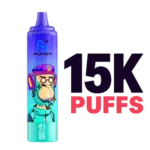 Sigarette elettroniche da 15.000 boccate
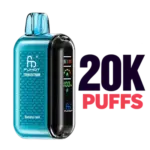 Sigarette elettroniche da 20.000 boccate
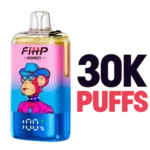 Sigarette elettroniche da 30.000 boccate
 Sigarette elettroniche da 40.000 boccate
 Sigarette elettroniche da 50.000 boccate
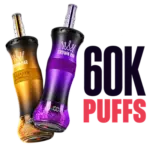 Sigarette elettroniche da 60.000 boccate
 Sigarette elettroniche da 80.000 boccate
 Sigarette elettroniche da 100.000 boccate