







Blog
Can You Take Disposable Vapes on an Airplane

Yes, on many routes you can take a disposable vape on an airplane, provided your airline and the countries on your itinerary allow it. When permitted, it belongs in your carry-on baggage or on your person, never in checked luggage. Prevent accidental activation, and do not use or charge it aboard the aircraft.
The FAA rules for electronic smoking devices establish the U.S. cabin-only requirement. However, passing airport security does not establish that you can legally bring the device into another country. This guide uses U.S. rules as its starting point and identifies international checks separately. Sources were checked on October 10, 2026.
Where a disposable vape can travel
Use this table after confirming that your airline and itinerary permit the device. A disposable vape remains an electronic smoking device even if it is sealed, rechargeable, or marketed as nicotine-free.
| Situation | General answer when carriage is permitted | What to do |
| Carry-on bag | Allowed subject to applicable rules | Protect the device against damage and accidental activation. |
| Checked suitcase | Not allowed | Remove the complete disposable before checking the bag. |
| Carry-on taken at the gate | Must not remain in the bag going into the hold | Transfer the whole device to your permitted personal item or carry it as staff direct. |
| During the flight | Carriage does not permit use or charging | Leave it unused and disconnected from all power sources. |
TSA guidance on electronic cigarettes and vaping devices specifies carry-on baggage only and effective protection against accidental heating. The U.S. Department of Transportation also explains the checked-baggage and onboard charging prohibitions, alongside the smoking ban that includes electronic cigarettes.
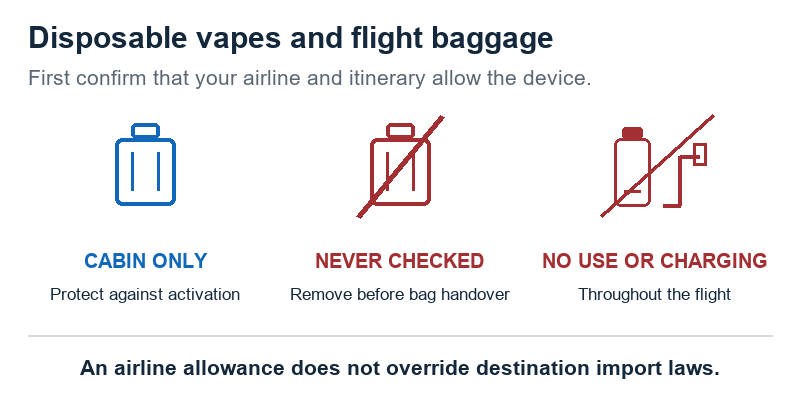
Confirm the airline and itinerary first, then keep a permitted device protected in the cabin.
Check the whole route before packing
Four different authorities can affect your trip. Aviation rules govern battery carriage. Security authorities decide what can pass a checkpoint. Your operating airline sets its baggage conditions. Customs and local law determine whether you can import, possess, or use the device after arrival.
Start with the operating airline for every flight, including connections. A ticket sold by one airline may include a segment flown by another. Read the operating carrier’s restricted-items page and search for “electronic cigarettes,” “vapes,” or “electronic smoking devices.” Check the quantity allowance and any route-specific prohibition rather than relying on a general electronics page.
IATA’s passenger guidance notes that some airlines prohibit vapes entirely, while others allow them in cabin baggage. A permission you find for one carrier therefore cannot settle the rules for your entire itinerary.
For an international journey, check official customs or health-authority information for the destination and any transit countries. Include the return journey. If a transit rule is unclear, ask the airline and the relevant authority before departure; do not assume remaining airside creates an exemption.
Save the current policy pages with your travel documents. If you contact the airline, give your device model, the number of devices, battery specifications, and every flight segment. A precise question is easier to resolve than asking whether “vaping is allowed,” which could mean carriage, airport use, or use aboard the plane.
How to pack a disposable vape for a flight
Keep the complete device in the cabin and use the manufacturer’s transport instructions. Packing a sealed disposable does not require opening its housing or removing an internal battery.
- Inspect it before travel. Do not pack a device with a swollen, punctured, or damaged battery. If it is leaking, unusually hot, or behaving abnormally, stop using it and seek guidance before bringing it to the airport.
- Switch it off or engage its transport lock if the exact model provides one. Confirm how that control works from the instructions.
- Prevent accidental activation using an appropriate protective case or another effective method specified for the device. An automatic draw device may have no power button, so “switch it off” alone is incomplete advice.
- Protect it against crushing and keep it accessible in a permitted cabin bag. Avoid packing it deep inside a suitcase that may be taken for hold transport.
- Disconnect every charging cable. A USB socket on the device does not create permission to charge it on the aircraft.
IATA’s 2026 lithium-battery guidance requires protection against damage and unintended activation for electronic cigarettes carried in cabin baggage. Do not assume a mouthpiece cap, retail box, or soft pouch automatically satisfies that requirement; assess the device’s actual controls and follow the airline’s instructions.
Check battery information rather than puff count
For U.S. carriage, each lithium-ion battery in an electronic smoking device must not exceed 100 watt-hours; the corresponding limit for a lithium-metal battery is 2 grams of lithium. These limits appear in 49 CFR 175.10(a)(19). Do not apply the airline-approval allowance sometimes seen for larger electronics to a vape.
Puff count and liquid capacity do not tell you the battery’s watt-hour rating. Keep the manufacturer’s specifications available without dismantling the device. IATA explains that an airline may refuse a lithium-battery device if staff cannot verify its watt-hour rating from the battery or documentation. Ask the manufacturer for missing battery information before travel, and ask the airline whether that documentation is sufficient.
If your carry-on is taken at the gate
Remove the whole disposable vape before the bag goes into the aircraft hold. This applies even if you planned to carry the suitcase aboard and already passed security.
British Airways explicitly tells passengers to remove vapes and other electronic smoking devices from cabin bags that are checked or taken at the gate, then carry them in a smaller cabin bag or on their person. Follow your own airline’s directions about the permitted cabin item.
For example, if an agent tags your roller bag because the overhead bins are full, pause before handing it over. Tell the agent it contains an electronic smoking device, retrieve the protected device, and transfer it to the item staying with you. Do not try to extract a sealed battery at the gate. If the bag has already been collected, alert staff immediately so they can decide what to do.
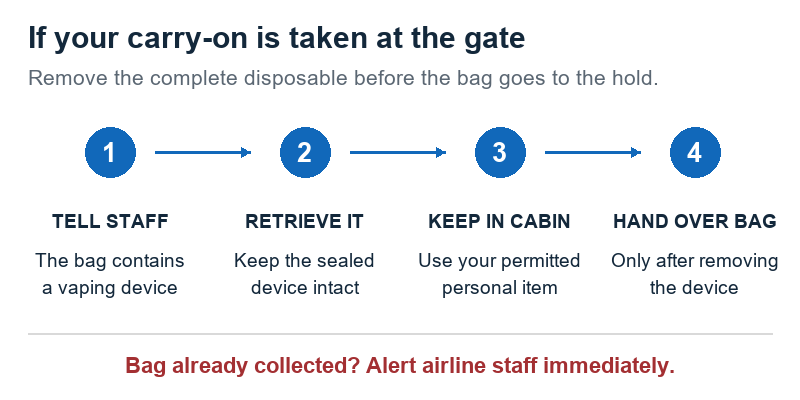
A carry-on that is taken for hold transport must no longer contain the disposable vape.
Liquid rules and the device are separate checks
For U.S. security screening, separate e-liquid bottles generally fall under TSA’s liquids rule: containers must hold no more than 3.4 ounces or 100 milliliters and fit in the passenger’s quart-sized liquids bag. A partly empty bottle larger than the permitted container size does not qualify simply because little liquid remains.
A sealed disposable contains both a battery-powered smoking device and liquid. Follow checkpoint instructions for presenting it. Do not open or drain it to satisfy screening, and do not move it into checked luggage because you have read general advice to check larger liquids. The electronic-smoking-device restriction still applies.
Outside the U.S., verify local screening rules. UK government guidance says liquid limits depend on the airport: most apply a 100 ml container limit, while some allow containers up to 2 liters. Check departure, transfer, and return airports individually. A scanner upgrade at one airport does not establish the allowance at the next checkpoint.
You cannot vape or charge aboard the aircraft
Leave the device unused throughout the flight, including in the lavatory. Charging is also prohibited, whether you would connect it to a seat USB port, a laptop, or a power bank. Carrying a rechargeable disposable does not change that rule.
The DOT’s electronic-cigarette rule and IATA’s passenger advice make the distinction between transporting and operating the device clear. At the airport, check signs and local rules separately; permission to carry it through a terminal is not permission to use it there.
If a device becomes hot, starts smoking, or appears damaged during the journey, tell cabin crew or airport staff immediately and follow their instructions. IATA’s incident guidance advises against trying to cool or move a smoking or overheating device yourself.
International arrival can change the answer
An airline’s cabin-baggage policy cannot override a country’s import prohibition. Singapore and Thailand illustrate why a general “yes” answer is insufficient for international travel.
Singapore’s Health Sciences Authority identifies prohibitions involving vaporiser possession, use, import, and supply. Its 2026 enforcement update also warns about travelers bringing prohibited vaping products into Singapore. Thai Customs identifies electronic cigarettes as prohibited imports into Thailand. Do not bring a disposable on those journeys based solely on an airline’s general allowance.
These examples are not a complete country list. Recheck official destination information close to departure. If the itinerary prohibits the device, arrange lawful disposal or storage before the trip rather than expecting security or customs to hold it for your return.
Frequently Asked Questions
Can I bring more than one disposable vape
Check your operating airline’s specific quantity limit and the destination’s import rules. There is no single worldwide allowance. The FAA directs passengers to check airline limits for electronic smoking devices carried for personal use; a general spare-battery limit is not automatically a disposable-vape allowance.
Does an unopened disposable vape follow different rules
No. Factory packaging does not remove the installed battery or the electronic-smoking-device classification. Keep it out of checked luggage and confirm that its packaging protects against accidental activation and damage. An unopened product can still be prohibited by the destination.
Can a nicotine free disposable go in checked luggage
No. Removing nicotine does not remove the battery or heating element. The TSA device rules concern electronic smoking devices, so a nicotine-free label does not create an exception to cabin-only carriage.
What if my disposable has no off switch
Use an effective method to prevent unintended activation, following its instructions and the airline’s requirements. A suitable protective case is one option identified in FAA guidance. If you cannot establish how to protect the model adequately, resolve that before travel rather than improvising at boarding.
Do UK flights allow disposable vapes in hand luggage
UK government guidance lists electronic cigarettes as permitted in hand luggage and prohibited in hold luggage. You must still check the airline, the destination, and applicable liquid-screening requirements. This baggage allowance does not permit onboard use or charging.
Does buying a vape in duty free make it allowed
No automatic permission follows from the purchase. Confirm the airline’s device policy and destination import rules before buying. Any liquid-screening arrangement for duty-free goods does not override the cabin-only battery rule or a country’s prohibition on electronic cigarettes.
What should I do if I packed it in a checked suitcase
Remove it before handing over the suitcase. If you discover the mistake after the airline has accepted the bag, notify airline staff immediately and explain that it contains an electronic smoking device. Let staff arrange the response rather than waiting until arrival.
Sources and Further Information
Research and access date: October 10, 2026. U.S. rules form the baseline; UK guidance, an airline example, and destination restrictions are identified separately. Recheck the authorities relevant to your actual itinerary before departure.
- FAA PackSafe electronic cigarettes and vaping devices — U.S. carriage, activation protection, battery limits, and charging restrictions; updated April 13, 2026.
- 49 CFR 175.10(a)(19) — U.S. regulatory conditions for electronic smoking devices and their batteries.
- TSA electronic cigarettes and vaping devices — U.S. checkpoint baggage classification and device requirements.
- DOT bans electronic cigarettes from checked baggage — U.S. final rule and explanation of the use and charging prohibitions.
- IATA passenger lithium-battery guidance for 2026 — Device protection and verification of battery specifications; March 31, 2026 edition.
- IATA safe travel with lithium batteries — Airline differences and responses to damaged or overheating devices.
- British Airways restricted and prohibited items — Airline example with explicit instructions for bags taken at the gate.
- TSA liquids aerosols and gels rule — U.S. carry-on liquids limits.
- UK airport liquids guidance and electronic-device guidance — Airport-specific liquids rules and electronic-cigarette baggage classification.
- Singapore HSA vaping enforcement and April to June 2026 enforcement update — Singapore prohibitions and traveler enforcement.
- Thai Customs electronic-cigarette import notice — Thailand import prohibition.
 9000 Puff Vapes
 12000 Puff Vapes
 15000 Puff Vapes
 20000 Puff Vapes
 30000 Puff Vapes
 40000 Puff Vapes
 50000 Puff Vapes
 60000 Puff Vapes
 80000 Puff Vapes
 100000 Puff Vapes
2 gedachten over “Can You Take Disposable Vapes on an Airplane”