







Blog
How Long Does 100 ml of E Liquid Last

To estimate how long 100 ml of e-liquid lasts, divide the usable volume available by the average volume leaving your supply each day. At a hypothetical 2 ml per day, 100 ml represents 50 days; at 5 ml per day, it represents 20 days. These are arithmetic examples, not recommended consumption levels, health limits or expiry dates.
The useful input is your own existing pattern in a compatible refillable device. If that pattern is unknown, there is no dependable universal answer in days. A bottle label gives volume; it does not establish how quickly an individual will use it.
Start with the volume actually available
A new supply labeled 100 ml and a partly used supply that originally contained 100 ml are different starting points. Use the amount reasonably available now. If you cannot estimate the remainder confidently, keep the uncertainty visible rather than treating the original label as a current measurement.
Also distinguish the liquid in the bottle from liquid already transferred to a tank or pod. You can estimate when the bottle will need replacing or when the combined usable supply will finish, but those are different questions. Define which one you are calculating and avoid counting the same transferred liquid twice.
Our explanation of what e-liquid is and what is in it separates liquid volume from concentration and other label information. For a duration estimate, the denominator must be a volume per day, not battery capacity or nicotine concentration.
Use a transparent calculation
Estimated days equals available milliliters divided by average milliliters per day. The unit relationship matters: milliliters divided by milliliters per day leaves days. The result is conditional on both inputs remaining applicable.
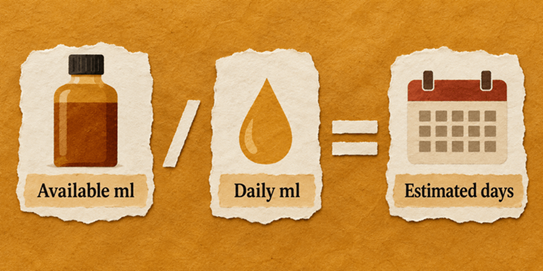
The estimate depends on available volume and observed daily volume; it is not a consumption target.
| Hypothetical available volume | Hypothetical daily volume | Arithmetic estimate |
| 100 ml | 2 ml per day | 50 days |
| 100 ml | 4 ml per day | 25 days |
| 100 ml | 5 ml per day | 20 days |
| 60 ml remaining | 4 ml per day | 15 days |
Every row is an illustration, not an observation of a tested person or device. It does not tell a reader how much to use. The last row demonstrates why the original bottle size should not replace the actual remaining supply.
If existing daily observations range from 3 to 5 ml, a 100 ml supply gives a simple conditional range of about 20 to 33 days. The shorter endpoint uses the larger daily volume. This is a scenario range, not a statistical confidence interval or a guaranteed delivery window.
Observe existing use without creating a target
Use ordinary records from a compatible refillable system, such as documented refill quantities or reasonable bottle-level observations. Keep the device, period and method with the estimate. Do not start additional use, repeatedly activate a device or transfer liquid into an unsuitable measuring container merely to make a precise-looking number.
Bottle graduations may only provide an approximate reading. A count of refills is informative only when the amount added at each refill is known. For example, multiplying a tank’s nominal capacity by every top-up can overstate the volume transferred when the tank was not empty beforehand.
Account for spills or other losses separately where known. A supply running down includes liquid lost from that supply, which is not the same as liquid aerosolized or nicotine absorbed. This distinction prevents a useful inventory estimate from being presented as a dose calculation.
After several ordinary days, compare your observations with the initial assumption. If the volume cannot be estimated reliably, report a broad planning range or leave the duration unresolved. An uncertain input remains uncertain after division.
Do not substitute puff counts or battery figures
An advertised puff figure cannot automatically supply a milliliters-per-day input. Vuse’s methodology describes machine puff counts under controlled conditions, including a stated draw duration and output endpoint. That manufacturer’s method is not a personal liquid-consumption measurement.
Our puff count versus liquid capacity comparison explains the missing conditions. Turning a headline count into a universal number of puffs per milliliter would introduce another unsupported assumption before the duration calculation even begins.
Battery capacity in mAh describes electrical capacity, not the liquid available. A power setting identifies an operating condition, not a complete consumption rate. A change of device or mode may make earlier observations less applicable, so update the observed volume input rather than inventing a conversion from the setting.
Nicotine strength is another separate quantity. A label in mg per ml does not state daily milliliters, and a duration estimate establishes no safe intake or amount absorbed. Do not alter strength or increase consumption to make the bottle finish on a chosen date.
Keep use duration separate from expiry
An arithmetic result of 50 days says what the supply could represent under its assumptions. It does not establish that the liquid remains suitable for 50 days, override the manufacturer’s date or extend an after-opening instruction. Follow the actual product label and ask the manufacturer when its dating is unclear.
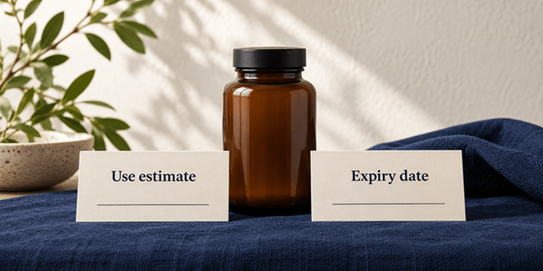
A supply estimate and the manufacturer date answer separate questions.
FDA recommends keeping e-liquids in their original containers, securing their caps and storing them out of children’s and pets’ reach and view. Preserve identification while estimating supply; a more convenient unmarked container can remove information needed for correct handling.
Our disposable expiry guide discusses the distinct product-date question for sealed devices. Its device context does not establish a universal shelf life for an opened refill bottle. Color or flavor alone cannot provide a replacement expiry date.
Recalculate when the situation changes
An estimate is most useful as a dated planning note: current volume, observed period, approximate daily volume and assumptions. Recalculate when the remaining volume, device or ordinary pattern changes. There is no need to create a daily performance target or consume a supply faster because a forecast suggests a long duration.
Finally, owning a bottle does not make a sealed disposable refillable. Only use liquid in a device whose instructions permit that filling task and the relevant liquid. If the device or liquid cannot be identified, resolve that question before treating the bottle as an available supply for it.
Frequently asked questions
Will 100 ml last a month
It may under some existing patterns, but volume alone cannot establish that. Divide available volume by your observed average daily volume and retain the assumptions.
What if the bottle is half used
Use the estimated remainder rather than the original 100 ml label. Avoid implying that an approximate level is an exact measurement.
Is ml the same as mg
No. Milliliters describe volume and milligrams describe mass. A strength in mg per ml is not a daily volume input or an absorbed-dose measurement.
Can I put the bottle into any disposable
No. A sealed disposable does not gain refill permission because liquid is available. Follow the exact device’s intended filling system and compatibility directions.
Does the calculation predict expiry
No. Supply duration and manufacturer dating are separate questions. Follow the actual label and clarify unknown dates with the manufacturer.
What if I do not know my daily volume
Use existing ordinary records if available. Otherwise keep the estimate unresolved or clearly hypothetical rather than borrowing another person’s rate as a prediction.
Sources and Further Information
Source check date: October 30, 2026. Numerical examples are explicitly hypothetical editorial calculations, not consumption recommendations or measured endurance results.
 9000 Puff Vapes
 12000 Puff Vapes
 15000 Puff Vapes
 20000 Puff Vapes
 30000 Puff Vapes
 40000 Puff Vapes
 50000 Puff Vapes
 60000 Puff Vapes
 80000 Puff Vapes
 100000 Puff Vapes