







Blog
PG vs VG in E Liquid and Device Compatibility

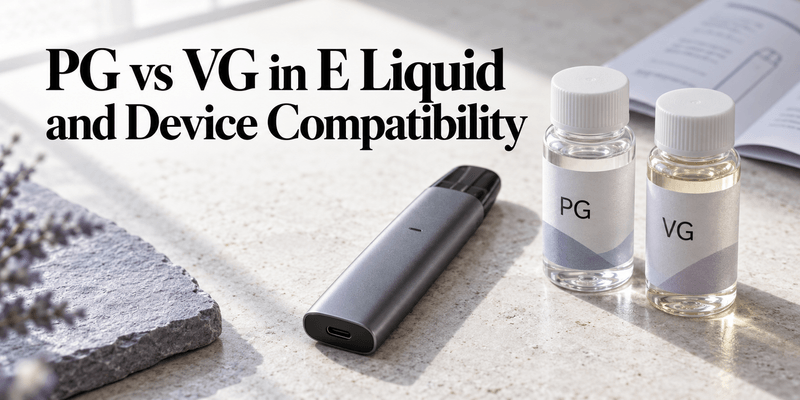
PG means propylene glycol, while VG means vegetable glycerin. PG is less viscous and VG is thicker; their proportions help shape how a finished e-liquid flows and behaves in a device. The ratio alone does not tell you its nicotine strength, prove that it is safe to inhale, or establish compatibility with every pod or coil.
For a refillable device you already own, start with the manufacturer’s liquid guidance for the exact pod or coil. For a sealed disposable, use its documented configuration rather than opening it to change the mixture. This guide explains the labels and decisions for adult existing users, without home-mixing instructions.
What PG and VG do in e liquid
The FDA describes e-liquids as mixtures that can include nicotine, flavorings, propylene glycol, vegetable glycerin and other ingredients. Heating that liquid creates an aerosol. PG and VG are therefore ingredients in a formulation, rather than complete descriptions of everything a user inhales.
PG and VG commonly provide the base in which other ingredients are carried. Innokin’s ingredient explanation describes PG as a solvent and distinguishes its lower viscosity from VG. The practical point is that the base affects the finished mixture’s properties, while flavorings and other ingredients also matter.
Do not read vegetable as a safety claim or assume that a bottle contains only the two base liquids. A product’s ingredient information, nicotine concentration and device instructions answer different questions. A front label emphasizing one feature may leave the others unresolved.
How to read a PG and VG ratio
Check the order of the letters before interpreting the numbers. A hypothetical label reading VG/PG 70/30 expresses the same stated relationship as PG/VG 30/70. Reading only 70/30 can reverse the meaning if you silently assume the wrong order.
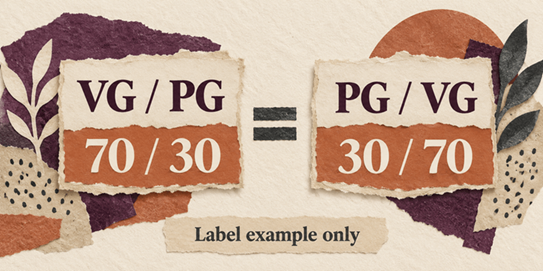
Read the letters before the numbers. These are label examples, not a mixing recipe or a device recommendation.
Those numbers are an example for reading a label, not a recommendation for your device or a mixing recipe. Check whether the manufacturer describes the finished formulation or its base ratio, and ask for clarification if the labeling is incomplete. Do not calculate extra nicotine or add household ingredients to make the numbers match.
Nicotine strength is a separate specification, commonly expressed in mg/mL on a nicotine-containing liquid. A VG percentage cannot supply a missing nicotine concentration. Likewise, two liquids with the same stated base ratio can have different flavor ingredients or nicotine formulations. Treat them as different products unless their full specifications establish otherwise.
Why viscosity affects liquid delivery
A wick carries liquid toward the heating area. The formulation must move through the intended liquid path while the device operates within its design limits. Innokin’s glossary describes PG as having low viscosity, VG as having high viscosity, and the wick as the material that feeds the heater.
This helps explain why a formulation that suits one system may not suit another. A device intended for a thicker liquid can have different liquid openings and flow requirements from a small pod intended for a thinner formulation. Compatibility concerns the whole combination, including the consumable and the manufacturer’s settings.
More thickness is not automatically better. It does not repair a damaged seal, establish that a wick is receiving enough liquid, or make a leaking device suitable for continued use. If the problem is leakage, use the device-specific pathway in why a vape leaks and what to do instead of changing liquid blindly.
Similarly, a mesh label or resistance number cannot identify the required mixture. Innokin notes that some modern sub-ohm mesh designs operate at low wattage. That is one reason to check the actual specifications rather than build a rule around a single label. Our coil types guide separates heater geometry, resistance and compatibility.
What changes in sensation and visible aerosol
Manufacturer descriptions often associate higher PG content with a stronger throat sensation and higher VG content with a milder sensation and more visible aerosol. Innokin discusses these tendencies in its formulation overview. These are broad descriptions, not predictions that isolate the base ratio from the rest of a product.
For a meaningful comparison, identify what else changed. Comparing a high-power device with one liquid against a low-power pod with another does not reveal what the ratio alone caused. Flavor ingredients, nicotine formulation, airflow and settings can differ at the same time. A reader cannot infer a measured flavor improvement from two percentages on different boxes.
Visible output also provides no measurement of nicotine intake or health risk. A smoother sensation does not establish that an aerosol is harmless. Avoid using cloud size or perceived harshness as a substitute for the manufacturer’s ingredient and operating information.
How to check compatibility with an existing device
Read the liquid guidance alongside the exact device and consumable names. Start with what the manufacturer permits, then compare the label of the finished liquid you intend to use. Do not assume that every product described as a pod system has the same requirements.
| Detail to check | Question it answers | What it does not establish |
| PG/VG order and proportions | What base relationship is stated | Nicotine concentration or complete ingredients |
| Exact coil or pod variant | Which consumable is installed | A universal liquid recommendation for the brand |
| Manufacturer liquid guidance | Which formulations suit that combination | Permission to modify a sealed reservoir |
| Stated operating range | How that consumable is intended to operate | That more power corrects a flow or seal problem |
| Current device condition | Whether a problem needs support | That a different blend can restore a damaged device |
If the instructions do not identify a compatible range or liquid type, ask the manufacturer using the complete device and consumable names. That is more useful than a question containing only mesh, sub-ohm or high VG. Keep a photo of the liquid label available so the manufacturer can see the actual formulation information.
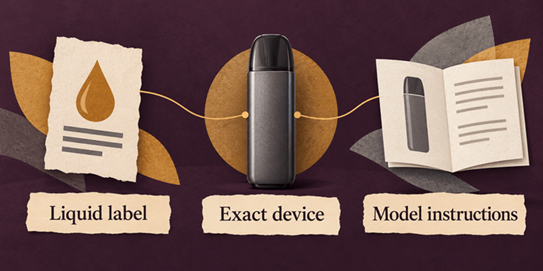
Compare the complete liquid information with the exact device and its instructions. This is a conceptual illustration.
A sealed disposable follows a different decision path. CDC distinguishes disposable devices from refillable systems and notes that some disposables can recharge without being designed for refilling. A charging port therefore does not authorize replacing the liquid or adjusting its PG/VG ratio. Our model-specific use guide explains why each capability needs separate confirmation.
What the ratio cannot tell you about safety
Food or cosmetic use of an ingredient does not establish that the finished heated aerosol is safe to inhale. CDC explains that some flavorings may be safe to eat but not to inhale, and that e-cigarette aerosol can contain harmful substances. A ratio is not a health certification.
Do not diagnose an allergy from throat sensation alone or keep testing different liquids through persistent discomfort. Stop using the product and seek appropriate medical advice for ongoing symptoms. This article does not establish a safest percentage, a harmless number of puffs or an individual medical explanation.
For equipment questions, the FDA recommends reading the manufacturer’s use and care directions and contacting it if instructions are missing. A ratio comparison should support that process rather than replace it.
Frequently asked questions
Is 70 VG the same as 70 PG
No. Read the named ingredient and the order of the ratio. VG/PG 70/30 and PG/VG 70/30 describe opposite proportions. Neither label alone establishes compatibility.
Does a PG and VG ratio tell me the nicotine strength
No. Find the nicotine concentration separately. A base percentage cannot tell you how much nicotine is present or how much a person receives during use.
Does every mesh coil need high VG liquid
No universal rule follows from mesh construction. Check the liquid guidance for the exact device and consumable; geometry and resistance do not replace that information.
Will thicker liquid fix a leak
It will not establish or correct the cause of every leak. Stop and follow the relevant troubleshooting and support directions, particularly for liquid near electrical areas or a leaking sealed device.
Can I change the ratio inside a disposable
Do not open or refill a sealed disposable to alter its formulation. If you need information about its contents, ask the manufacturer for that model’s specifications.
Which percentage is safest
This guide does not establish a safe inhalation percentage. Compatibility, sensation and visible aerosol are different questions from health risk; no PG/VG label makes vaping harmless.
Sources and Further Information
Source check date: October 26, 2026. Manufacturer material supports descriptive properties within its stated scope; no comparative product testing was performed.
- FDA overview of e-liquids and ENDS.
- Innokin e-liquid ingredients, August 30, 2024.
- Innokin glossary, PG, VG and wick entries.
- Innokin sub-ohm design explanation, August 24, 2021.
- CDC e-cigarette types.
- CDC health effects of vaping.
- FDA vape use and care guidance.
 9000 Puff Vapes
 12000 Puff Vapes
 15000 Puff Vapes
 20000 Puff Vapes
 30000 Puff Vapes
 40000 Puff Vapes
 50000 Puff Vapes
 60000 Puff Vapes
 80000 Puff Vapes
 100000 Puff Vapes
3 thoughts on “PG vs VG in E Liquid and Device Compatibility”