







Blog
Why a Vape Leaks and What to Do

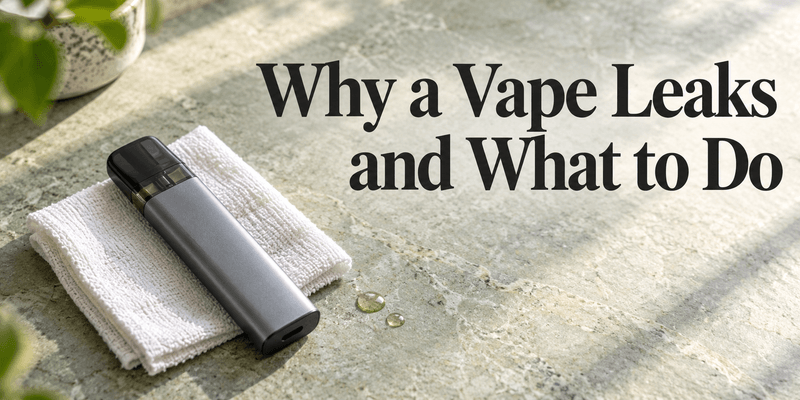
A vape can leak when liquid escapes through a damaged or poorly fitted seal, an overfilled reservoir, or a flooded airflow path. A light film of condensation can resemble a leak, but appearance alone cannot identify an unknown liquid. Stop using the device while you assess it. The appropriate response depends on whether it is a refillable system with permitted maintenance or a sealed disposable.
Do not keep using or charging a leaking sealed device, and do not open it to repair the problem. This guide is for adults who already own a device; it explains observations and documented checks rather than a universal repair procedure.
First separate condensation from a recurring leak
Start with where the liquid appears and whether it returns. Innokin’s discussion of pod leakage distinguishes small condensation deposits under a pod from larger liquid accumulation. That distinction can guide an inspection, but it does not prove that any particular damp device is harmless.
Condensation forms when material from the aerosol settles on cooler surfaces. A reservoir leak involves liquid leaving its intended containment. This explains why a film and a reservoir leak can look similar without having the same source. Both can leave a film near the mouthpiece or pod, so there is no reliable color or smell test that replaces the device instructions.
| Observation | What it may indicate | Appropriate next step |
| A light film at an accessible mouthpiece | Condensation or transferred liquid | Stop and follow the model’s external cleaning directions |
| Liquid repeatedly collecting at a seam | Containment or fitting problem | Check permitted components on a refillable model; seek support for a sealed one |
| Gurgling or droplets reaching the mouth | Liquid in the airflow path | Stop; do not keep drawing to clear it |
| Liquid at a charging port or damaged body | Possible contamination of electrical areas | Do not charge or test it; obtain device-specific advice |
Record the location before wiping an accessible exterior. A photograph taken without handling leaking material can help support distinguish a mouthpiece film from a seam leak. Never taste the liquid or test the device with repeated puffs to identify it.
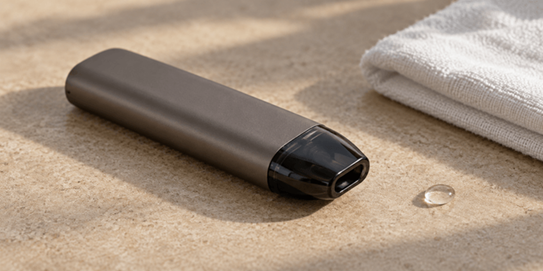
Observe liquid location without opening the device. This illustrative scene does not identify a leak or its cause.
Why liquid escapes
A refillable tank or pod must contain liquid while supplying an appropriate amount to its heater. Damaged seals, incomplete closure or incorrectly seated replaceable parts can undermine that containment. Filling past the model’s stated limit can also leave liquid where it does not belong. These are possible causes, not a diagnosis of every device that feels wet.
Flooding describes more liquid reaching the atomizer area than the system can manage. Innokin’s disposable troubleshooting article explains that a forceful draw can pull excess liquid from a wick into the airflow path. Gurgling or spitback can accompany that problem, but they do not identify which seal or component has failed.
Liquid formulation and environmental pressure can also matter for some reservoir designs. The manufacturer’s leak discussion describes viscosity mismatch and pressure changes as possible contributors. Do not extend that explanation to every sealed reservoir or assume that all products use the same vacuum arrangement. A useful question is what changed just before the problem: a refill, a replaced part, a drop, transport or storage conditions?
Temperature is another reason to review storage. The FDA advises protecting vapes from extreme temperatures, including hot cars and direct sun. That is a care requirement, not proof that cooling a leaking device restores its condition. Do not use a freezer, hair dryer or external heater as a repair.
What to check on a refillable pod or tank
Read the instructions for the exact device and consumable before removing a part. Refillable does not automatically mean that every component is washable or user serviceable. A removable pod and the powered body have different maintenance limits.
For example, the original Innokin Klypse quick guide identifies a dedicated fill tab that must close securely and requires the pod and contacts to be free of e-liquid residue. Those are instructions for that refillable model, not permission to remove a disposable’s mouthpiece. For your own device, check its stated filling limit and compatible consumable. Inspect accessible seals only as its manual permits; do not trim gaskets or improvise seals with glue or tape.
Then check whether the liquid and operating settings match that model’s guidance. Raising power or changing liquid is not a universal leak fix. The wrong adjustment may introduce another problem without correcting the original containment fault. If a permitted replacement is needed, use the specified component rather than one that merely looks similar.
These checks help distinguish a maintenance error from an unresolved defect. If liquid returns after the documented steps, stop further experimentation and contact support. Do not rinse the powered body or use charging as a test. Our disposable cleaning guide explains the distinction between accessible exterior care and unsupported internal access.
What changes with a sealed disposable
A sealed disposable does not offer the same maintenance permissions as a refillable tank. For a concrete example, the GEEKBAR HERO instructions prohibit opening or tampering and tell users not to use or repair a damaged or leaking unit. That warning takes priority over generic advice about correcting a draw or clearing a wick on that model.
For a leaking sealed device, stop use and contact the manufacturer or seller about its support or return process. Confirm handling instructions before transporting a damaged or leaking item. If it must be discarded, use a collection route that accepts the complete device in its actual condition; do not extract the battery or drain the remaining liquid. See our US whole-device disposal guide for the collection questions to ask. Elsewhere, confirm the local rules and receiving operator rather than assuming the US route applies.
Do not blow forcefully through the device, insert needles, shake liquid out or pry off the housing. Those actions do not establish that the leak is resolved. A rechargeable label also does not authorize repair: a charging socket is not a service opening. Confirm capabilities separately using the instructions for the actual model.
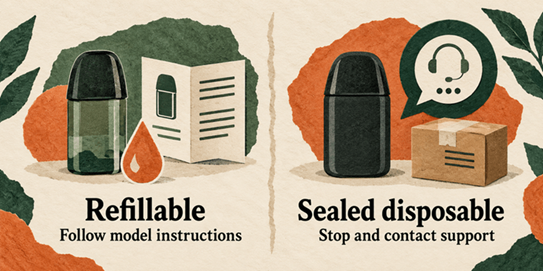
Permitted maintenance depends on the device. A sealed disposable is not a refillable tank.
Keep liquid exposure separate from troubleshooting
Avoid touching unknown liquid and keep the device away from children and pets. If e-liquid contacts skin, the FDA advises washing the area thoroughly with soap and water. It also advises rinsing eyes thoroughly with water after contact and seeking medical attention if vision changes.
In the United States, call Poison Control at 1-800-222-1222 immediately if someone drinks e-liquid, or if you suspect a child has been exposed. Outside the US, contact the appropriate local poison service. Do not wait to identify the coil type or finish a device inspection before obtaining exposure advice.
For abnormal heating, smoke or other signs of active failure, move away and seek emergency help rather than handling or charging the device. FDNY battery guidance calls for immediate discontinuation when a battery overheats or shows other warning signs; its US emergency contact is 911. A wet charging port should not become a trial to see whether the indicator still works. Keep electrical safety and liquid cleanup ahead of attempts to recover a usable device.
How to reduce repeat problems
For a serviceable refillable system, follow the specified filling limit, close the fill port correctly, and use compatible consumables and liquid. Store and carry it as its instructions require. These are ways to avoid known setup errors; none guarantees that a product will never leak.
Keep a short record of when the issue occurs. Leakage immediately after fitting a new pod suggests a different question for support than liquid appearing after a drop. Include the model, consumable name, liquid label where relevant, location of the liquid and any damage. That information helps the recipient give a model-specific answer instead of another generic tip.
Frequently asked questions
Why is liquid coming from the bottom
The bottom may include an airflow opening, a pod connection or electrical areas. Its location alone does not reveal the cause. Stop use and inspect only the accessible areas permitted by the instructions.
Does gurgling prove that a seal is broken
No. It can accompany liquid in the airflow path, including flooding. It is a symptom to report, not a reliable diagnosis of a particular failed part.
Can I charge a vape after wiping away a leak
Wiping the outside does not establish that electrical areas are dry or undamaged. Do not charge a leaking or liquid-contaminated device to test it; follow its support instructions.
Will shaking the device clear the liquid
Do not shake a leaking sealed vape as a repair method. It may move liquid elsewhere without correcting its source, and it does not show whether the device remains usable.
Should I use thicker liquid to stop leakage
Only use a formulation compatible with a refillable device’s instructions. Greater viscosity is not a universal solution, and a sealed disposable should not be opened or refilled to change its liquid.
What if a brand new disposable leaks
Stop using it and contact the seller or manufacturer with the model and condition. Being new does not rule out a defect or transit damage, and it does not justify trying to repair it.
Sources and Further Information
Source check date: October 23, 2026. Device maintenance permissions vary by model. Exposure contact details above are explicitly US guidance.
- Innokin explanation of vape leaks, October 27, 2024; manufacturer descriptions of possible causes.
- Innokin disposable troubleshooting, limited to the explanation of forceful draws and flooding.
- Original Innokin Klypse quick guide, English section on page 1; model-specific filling and contact-care example.
- FDNY lithium-ion battery guidance, September 3, 2021; battery warning signs.
- GEEKBAR HERO user instructions, model-specific no-tamper and leaking-device warnings.
- FDA vape battery care.
- FDA e-liquid exposure prevention and response.
 9000 Puff Vapes
 12000 Puff Vapes
 15000 Puff Vapes
 20000 Puff Vapes
 30000 Puff Vapes
 40000 Puff Vapes
 50000 Puff Vapes
 60000 Puff Vapes
 80000 Puff Vapes
 100000 Puff Vapes
One thought on “Why a Vape Leaks and What to Do”