







Blog
What Is E Liquid and What Is in It

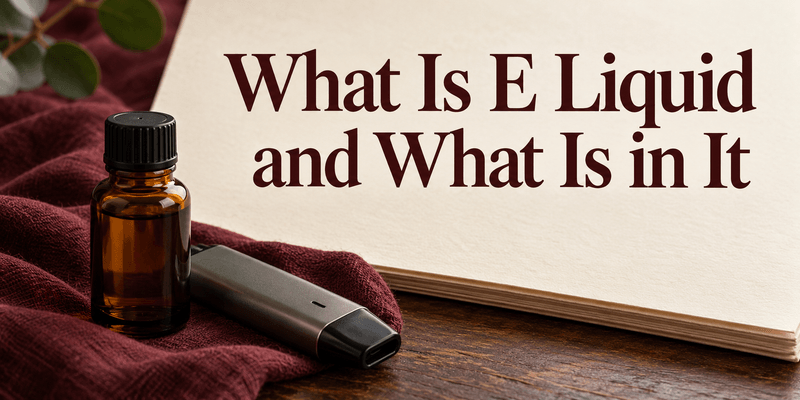
E-liquid, also called vape juice, is a formulated liquid that an e-cigarette heats to produce aerosol. Common ingredients include propylene glycol, vegetable glycerin, flavorings and often nicotine. The exact formulation varies, so a flavor name or PG/VG ratio does not describe everything in a product or establish that it is safe to inhale.
For adults reading the label of a product they already own, the practical task is to separate ingredients, liquid volume, nicotine information and device instructions. Each answers a different question. This guide explains those distinctions without providing a mixing recipe or a recommendation to begin vaping.
E liquid is the formulation before heating
The FDA overview of electronic nicotine delivery systems describes e-liquid ingredients and the heating that creates inhaled aerosol. E-liquid is the material supplied to the heating system. Aerosol is what the device produces during operation. The words are related, but they do not name the same physical material at the same stage.
The container can also differ. Liquid may be supplied in a bottle for an intended refillable system, inside a prefilled cartridge, or within a disposable device. CDC distinguishes refillable devices, prefilled cartridge or pod systems, and disposables. Where the liquid is held does not by itself tell you whether a user may add more.
A bottle and a device therefore need different information. The bottle identifies a formulation; the device instructions establish how that equipment is intended to operate. Our explanation of how vapes work follows the separate liquid, heating, electrical and airflow functions. Naming a function does not make an internal component accessible.
Common ingredient groups and their roles
Propylene glycol, abbreviated PG, and vegetable glycerin, abbreviated VG, commonly form the liquid base. Innokin’s ingredient explanation describes PG as a solvent and distinguishes its lower viscosity from VG. The base helps carry other formulation ingredients; its physical properties also affect how the finished liquid behaves.
Flavorings contribute to a product’s intended sensory profile. A name such as mint or strawberry describes that profile, rather than proving that the liquid contains a particular plant, juice or complete ingredient list. Different formulations can use the same broad flavor description. Read the actual ingredient information instead of treating the front label as a chemical analysis.
Nicotine, when present, is a separate formulation component. Its stated concentration is different from the amount of liquid in the container and from the proportion of PG or VG. A familiar flavor or a smooth sensation cannot supply missing nicotine information.
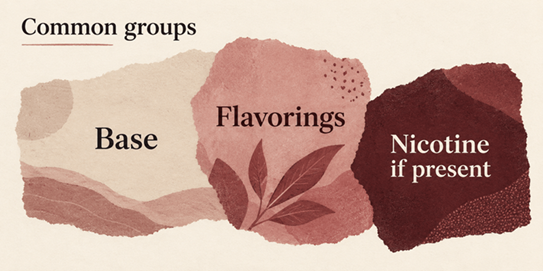
Common ingredient groups only. This illustration is not a complete product formula or a mixing recipe.
These are common ingredient groups, not a universal four-ingredient formula. FDA’s overview expressly allows for other ingredients. A general explanation cannot determine the contents of an unidentified bottle or certify an individual product. If a label or specification is incomplete, ask the manufacturer to identify the exact formulation and version.
The detailed relationship between base proportions and device requirements is covered in our PG and VG guide. It is a separate question from identifying the whole finished formulation. A ratio label can be useful without telling you everything else in the liquid.
Read volume strength and base information separately
Start by attaching every number to its unit and description. Milliliters describe volume. Milligrams per milliliter describe a stated concentration. A PG/VG ratio describes a relationship between named base ingredients. These fields should not be substituted for one another.
For example, two containers with the same volume can have different stated nicotine concentrations. Two products with the same base ratio can have different flavors or other ingredients. The name of a nicotine form, where supplied, is also different information from its concentration; it does not replace the strength entry.
| Label field | Question it helps answer | What it does not establish |
| Liquid volume in ml | How much liquid is supplied | Nicotine concentration or battery energy |
| Nicotine concentration in mg/ml if stated | How nicotine content is expressed per volume | The amount absorbed by an individual |
| PG and VG information | Which base relationship is described | The complete finished ingredient list |
| Ingredient information | Which ingredients the manufacturer declares | A guarantee of harmless inhalation |
| Model and product identification | Which specification and instructions to consult | Compatibility with every device |
If the packaging uses a percentage without explaining its basis, ask for clarification rather than silently converting it into another unit. Likewise, do not infer strength from a color, a flavor name or a word such as smooth. Missing information should remain a question for the manufacturer.
Keep a photograph of the complete label when asking for help. Include the product name, version and the field that is unclear. That is more useful than sending only a cropped front image that omits the ingredient and instruction panels.
The bottle and the aerosol are different questions
Recognizing an ingredient does not settle the effects of inhaling a heated formulation. CDC explains that some flavorings may be safe to eat but not to inhale, and that e-cigarette aerosol can contain harmful substances. Food use and inhalation involve different exposure routes.
This is why terms such as vegetable, natural or food grade cannot serve as an inhalation-safety certificate. They may describe an ingredient or a supplier specification, but they do not establish the behavior of the complete product during use. The ingredient list and the aerosol are connected by heating and device operation, rather than being interchangeable descriptions.
Do not use taste or cloud appearance as a home safety test. A sweet flavor does not identify every ingredient, and a less harsh sensation does not measure exposure. CDC states that e-cigarettes are not safe; this article does not establish a safest base percentage, flavor or number of puffs.
An ingredient question also cannot diagnose a person’s symptoms. If a product causes persistent discomfort, stop using it and seek appropriate medical advice rather than repeatedly testing different liquids to identify a cause yourself.
Match the formulation to the device instructions
Knowing what e-liquid is does not make every bottle suitable for every device. The finished formulation and the intended pod, coil or tank need to be considered together. Follow the manufacturer’s guidance for that exact combination; a shared brand name or similar bottle shape is insufficient.
The device type also controls what the user may do. CDC notes that some disposables may recharge but are not designed for refilling. A charging port therefore does not establish permission to open a reservoir, add liquid or replace its ingredients.
Use our guide to the instructions for an actual disposable model to separate activation, recharging and liquid access. For a sealed product, keep the original liquid system intact. Do not add water, flavor concentrates, oils or other household ingredients to make an unknown formulation behave differently.
If the formulation or device cannot be identified, preserve the label and ask the manufacturer before proceeding. A generic ingredient guide cannot resolve an undocumented product combination.
Store identified liquid and respond to exposure
Keep liquid in its original identified container and secure the cap as directed. FDA recommends keeping e-cigarettes and e-liquids in safe elevated locations, out of the reach and view of children and pets, in their original containers. Do not transfer liquid to a drinks bottle or another container that loses its identification or suggests food.
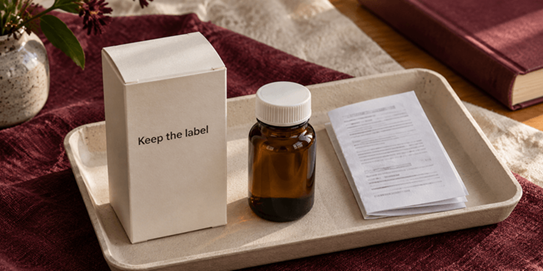
Retain the original container and identification. This is an illustrative scene, not proof of a particular formulation or storage condition.
Follow the actual product’s storage and date instructions. This is different from assuming that all liquids have one shelf life or that an unopened package proves good condition. Keep the identifying details available if a date or instruction is unclear.
Avoid liquid contacting skin or eyes. FDA advises washing skin thoroughly with soap and water after contact. If liquid enters the eyes, rinse thoroughly with water and seek medical attention if vision changes. These are exposure-response steps for a person, not directions to wash an electronic device.
In the United States, FDA advises calling Poison Control at 1-800-222-1222 immediately if anyone drinks e-liquid or if a child may have been exposed. Elsewhere, contact the appropriate local poison service. Do not wait to decode the flavor or base ratio before seeking exposure advice.
Frequently asked questions
Are e liquid and vape juice the same thing
They are commonly used names for the formulated liquid used in an e-cigarette. The word juice does not mean it is a drink or suitable for swallowing. Use the complete product label to identify its contents.
Does every e liquid contain nicotine
No universal nicotine content follows from the term e-liquid. Read the actual nicotine information for that product. A general category, flavor name or PG/VG ratio cannot verify its concentration.
Does a fruit flavor mean the liquid is fruit juice
No. A flavor name describes an intended sensory profile. It is not evidence of a complete ingredient list or permission to add ordinary juice or food flavorings to a device.
Does the PG and VG ratio describe the whole formula
No. It describes the stated relationship between those base ingredients. Nicotine, flavorings and other formulation information still need separate identification.
Can the same e liquid be used in every vape
No general ingredient description establishes that. Check the instructions for the exact device and consumable, including whether it is designed for refilling. Ask the manufacturer if the permitted liquid type is unclear.
Can I add bottled liquid to a rechargeable disposable
Rechargeability does not establish refillability. Do not open a sealed disposable to add liquid. Its battery and liquid system have separate operating permissions and endpoints.
Sources and Further Information
Source check date: October 28, 2026. Ingredient descriptions are general educational information, not a test of a particular product. Poison Control contact details above apply to the United States.
- FDA overview of e-liquids and electronic nicotine delivery systems.
- Innokin explanation of e-liquid ingredients, August 30, 2024; base and solvent descriptions only.
- CDC overview of e-cigarette device types.
- CDC health effects of vaping.
- FDA e-liquid storage and accidental exposure guidance.
 9000 Puff Vapes
 12000 Puff Vapes
 15000 Puff Vapes
 20000 Puff Vapes
 30000 Puff Vapes
 40000 Puff Vapes
 50000 Puff Vapes
 60000 Puff Vapes
 80000 Puff Vapes
 100000 Puff Vapes
4 thoughts on “What Is E Liquid and What Is in It”