







Blog
How Do Vapes Work

A vape uses electrical energy from a battery to power a heater. The heater acts on e-liquid, producing aerosol that moves through the device’s outlet with airflow. Liquid storage, electrical power and activation are separate functions, so a charged battery alone cannot make an empty or faulty device work normally.
This explanation concerns common e-liquid devices, including disposables and pod or tank systems. It is for adults understanding equipment they already have, rather than instructions for starting nicotine use or dismantling a device. The FDA overview of electronic nicotine delivery systems describes heating e-liquid to create an inhaled aerosol; the exact construction varies by product.
Follow energy and liquid through the device
The process is easier to understand when you follow electrical energy and liquid separately. The battery supplies electrical energy. Activation allows the device to power its heating system according to its design. The heater transfers energy to liquid near the heating area, rather than requiring the entire reservoir to boil at once.
The FDA’s technical guidance for ENDS applications describes an atomizer as a component using a coil to heat e-liquid electronically and produce aerosol. It also treats coil characteristics and wick absorbency as distinct product properties. The term atomizer can describe more of an assembly than the heating element alone, so a product’s terminology matters.
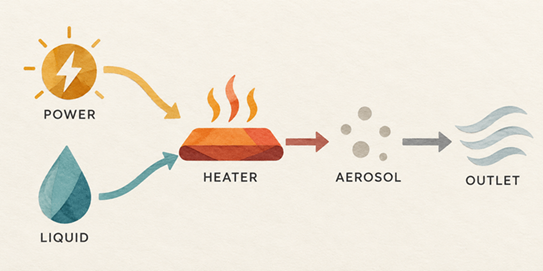
Functional relationships only. The illustration does not show the construction, wiring or component positions of a particular product.
In many designs, absorbent material supplies liquid to the heating area. PMI’s manufacturer description of e-vapor mechanics describes a wick drawing liquid onto a coil heating element. This explains a function, not a particular device’s internal arrangement or a permission to replace its wick.
Air passing through the intended route carries aerosol toward the mouthpiece. That air route and the electrical circuit have related roles, but they are not the same thing. An unobstructed outlet does not prove that the heater has power, and a lit display does not prove that liquid is reaching the heating area.
What the main parts do
The CDC device overview identifies a battery, a heating element and a place to hold liquid as common features. Packaging may use different names for the same general roles, while some products combine several roles in one sealed assembly.
| Part or function | Role in operation | What it does not establish |
| Battery and power controls | Supply and manage electrical energy | Remaining liquid or user battery access |
| Reservoir cartridge or pod | Hold the liquid supply | Permission to refill or remove the part |
| Heater and liquid supply material | Bring heat and liquid together | A universal coil replacement procedure |
| Air route and mouthpiece | Provide the intended route for aerosol | A user-adjustable airflow setting |
| Indicator or display if fitted | Report the functions assigned by the manufacturer | A complete diagnosis or absorbed nicotine dose |
These functions are a way to read a manual, not a map of where to cut or pry. A part being named does not make it accessible to the user. Even products with similar exterior shapes can have different assembly methods and service limits.
Draw activation and buttons perform an operating role
Some devices activate in response to a draw, while others use a button or a combination of controls. The activation system determines when power is supplied; it does not remove the need for an adequate liquid supply and a functioning heater.
For a named example, the GEEKBAR HERO manual identifies HERO as draw-activated and describes its own controls and indicators. This is evidence about that model. It does not establish a universal button sequence, lock behavior or control scheme for another GEEK BAR product.
Control circuitry can provide additional functions, but features need to be verified for the exact model. The FDA technical guidance discusses protection capabilities conditionally; their presence and limits must be verified for the actual product.
If a product activates unexpectedly, behaves abnormally or becomes damaged, its operation needs appropriate support rather than experimentation with internal contacts. The HERO manual specifically prohibits opening or tampering with that product. Never bypass a control to make a sealed device operate.
How disposable pod and refillable designs differ
The same broad heating process can appear in different product categories. According to the CDC, disposables are prefilled and may be rechargeable, but are not designed to be refilled. Refillable devices have a liquid chamber intended for filling, while systems with prefilled cartridges or pods use their own replacement arrangement.
Those categories explain why charging, refilling and replacing a pod are different tasks. A rechargeable battery does not imply a refillable reservoir. A replaceable pod does not imply that its internal heater is separately replaceable. Always check the actual manufacturer’s description rather than deciding from the word vape or from a visible seam.
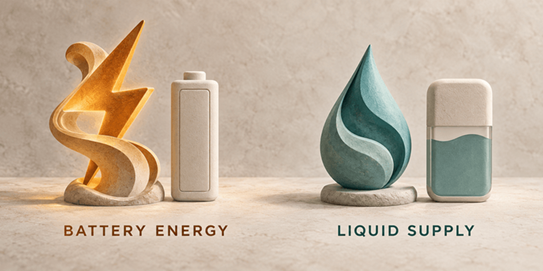
Charging addresses energy; it does not add liquid. Filling or replacement capabilities must be checked for the exact model.
For example, if the battery is low in a documented rechargeable device, the charging instructions address the energy supply. If the liquid is depleted in a sealed disposable, the same charging action cannot create more liquid. This is a functional distinction; it is not a recommendation to recover leftover liquid or convert a disposable into another category.
What affects output and what output cannot prove
The amount and character of aerosol can depend on several product properties. The FDA’s ENDS guidance asks manufacturers to describe coil resistance and materials, liquid capacity, draw resistance and the device’s operating range. These are separate considerations rather than a single performance score.
A larger battery, a screen or an advertised puff count cannot by itself establish how a product will behave in every situation. A battery-capacity label concerns stored charge, while a liquid-volume label concerns a different supply. Neither is a direct measurement of the nicotine a particular person absorbs.
Similarly, more visible aerosol is not a safety test, and a flavor change is not a complete diagnosis of internal condition. The relationship between components helps explain why symptoms can overlap. It does not let you identify a specific failure simply by watching a light or estimating the size of an aerosol cloud.
Use the explanation when reading a manual
Start by finding the model and the instructions for its actual functions. Our guide to disposable vape model instructions explains that matching process. Use its documented indicators to distinguish questions about power, liquid, activation and condition.
If the question is charging, our disposable vape charging guide covers the separate checks. The FDA’s device-care advice recommends following the manufacturer’s directions, protecting the device from extreme temperatures and charging where it remains visible on an appropriate surface.
Understanding the process helps identify the right instruction. It does not create a repair procedure for a sealed housing or justify using a device that is damaged, leaking or unusually hot.
Aerosol is more than water vapor
The CDC explanation of vaping health effects states that aerosol can contain harmful substances, including chemicals and particles. Heating liquid electronically does not establish that the resulting aerosol is harmless. Nicotine, when present, is addictive.
The working principle therefore answers how aerosol is generated, not whether a particular product is suitable for a person or a place. Reading a component diagram is not a health assessment or evidence that an unverified product meets a regulatory requirement.
Frequently asked questions
Does a conventional vape burn tobacco leaf
Conventional e-liquid devices heat liquid to form aerosol, as described in the FDA overview. This article concerns those devices. Products designed to heat tobacco leaf require a separate explanation and should not be assumed to have the same contents or operating arrangement.
Is the wick the same thing as the battery
No. In designs that use a wick, it helps supply liquid to the heating area. The battery supplies electrical energy. The names refer to different functions, even when both are contained inside one sealed product.
Why can a charged vape still be empty
Battery energy and liquid supply are separate. A charged battery cannot replenish exhausted liquid. A device can therefore show available charge while its liquid supply has reached its limit. Use the actual model’s directions for the appropriate next step.
Does a screen show how much nicotine someone absorbed
A screen reports only the information its manufacturer assigns to it. Battery or liquid information is not a measurement of a person’s absorbed nicotine dose. Do not convert a display reading into a personal exposure or safety claim.
Can every vape have a new coil installed
No universal replacement procedure follows from the presence of a heater. Some systems have documented replaceable components; a sealed disposable may not. Check the exact instructions before treating any part as user-serviceable, and do not dismantle a sealed product to reach it.
Does no aerosol prove the battery is dead
No. Activation, electrical power, liquid supply and the heating system all contribute to normal operation. An absent output does not identify which part has reached a limit or failed. Follow documented external checks and seek support rather than testing internal contacts.
Sources and Further Information
Source check date: October 22, 2026. This is a functional explanation of common e-liquid devices, not an internal layout or service manual. The manufacturer example concerns GEEKBAR HERO only.
- FDA overview of electronic nicotine delivery systems
- FDA ENDS application guidance revised March 2023
- PMI manufacturer description of coil and wick mechanics
- CDC overview of e-cigarette components and device types
- GEEKBAR HERO official instructions
- FDA battery and device-care guidance
- CDC vaping health information
 9000 Puff Vapes
 12000 Puff Vapes
 15000 Puff Vapes
 20000 Puff Vapes
 30000 Puff Vapes
 40000 Puff Vapes
 50000 Puff Vapes
 60000 Puff Vapes
 80000 Puff Vapes
 100000 Puff Vapes
2 thoughts on “How Do Vapes Work”