






Blog
Vape Coil Types Explained Including Mesh and Dual Mesh

Vape coil types include wound wire, mesh and designs with multiple mesh heating elements. These names describe the heater, while resistance, material and replaceability describe other properties. To identify the right consumable for a device you already own, check its exact compatible coil or pod family and operating instructions. A mesh or dual mesh label alone cannot establish fit, flavor quality or service life.
This guide explains those distinctions for adults who already use vaping devices. It covers factory-made coils and pods, with no instructions for building coils or opening a sealed disposable.
What a coil label actually describes
The word coil can mean the heating element or an entire replaceable coil head. A head may contain a heater, absorbent wick and housing. The wick supplies liquid to the heater; the housing holds the assembly in place. Innokin describes these parts separately, which helps explain why replacing a head is different from changing its internal wire.
Product labels often combine several classifications. Mesh describes heater geometry. Dual describes a count or arrangement that needs further explanation. A number followed by Ω gives electrical resistance. A material name describes composition. The FDA technical guidance, on printed page 50, likewise lists coil number, material and resistance as separate characteristics. This is a technical reporting framework, not approval of a particular replacement part.
For example, two listings may both say mesh while describing different sizes, sealing surfaces and connection systems. Treat the shared term as a description to interpret, rather than permission to interchange them.
Wound wire and mesh heating surfaces
A traditional heater uses resistance wire formed into a winding. A mesh heater uses a perforated strip or sheet. The different shapes change the area and distribution of contact with the wick, which is why manufacturers discuss geometry alongside liquid supply and heating behavior. Innokin’s coil technology overview describes replacing spiral wire with one or more mesh strips.
That distinction explains the term mesh even when the element is curved inside a head. It does not mean that a mesh coil is a filter, or that mesh describes the entire device.
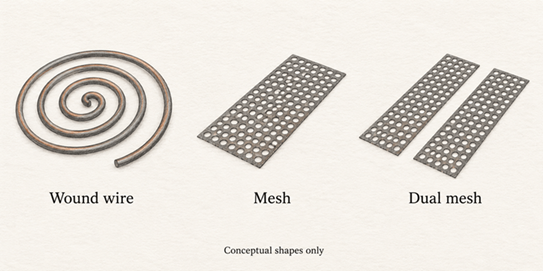
Conceptual geometry only, not a product layout, scale drawing or installation guide.
The shape also does not settle a comparison between complete products. A claimed flavor advantage would need a defined comparison: which liquid, power setting, airflow, device and coil condition? Without those conditions, a statement such as mesh tastes twice as good has no useful measurement behind it. Geometry can explain a design choice without proving a universal performance ranking.
What dual mesh does and does not tell you
Dual mesh generally refers to a design using two mesh heating elements, but the manufacturer’s documentation must explain their arrangement and operation. The label alone does not say whether both operate together, whether a mode changes their use, or whether the device offers any user control over them.
A concrete example is SMOK’s D-Coil description for the X-PRIV SOLO kit. SMOK identifies its 0.15 Ω and 0.23 Ω D-Coils as dual meshed, with different stated operating ranges. These are named consumables for a particular system, not interchangeable parts for disposable vapes.
Use the example to interpret documentation, rather than borrow its settings. Two heaters do not establish twice the flavor, twice the lifespan or twice the puff count. Nor does receiving two spare coils in a box mean that the installed coil has a dual-element design. The distinction is between the contents of a package and the construction of a part.
Resistance and material are separate specifications
Resistance is measured in ohms. Sub-ohm means below 1 Ω; it does not identify a material or guarantee a particular power requirement. Innokin’s explanation of modern sub-ohm designs specifically notes that some mesh designs operate at low wattage despite low resistance. Follow the stated range for the exact consumable, not a range copied from another coil with a similar number.
Mesh is also not a synonym for sub-ohm. The GEEKBAR HERO manual identifies a 1.2 Ω mesh coil, providing one model-specific counterexample. Its specification does not establish what is inside a different GEEK BAR model.
Material names such as a particular alloy form another classification. A resistance value cannot tell you which alloy was used. Similarly, the shape of a mesh sample cannot establish that a complete device supports a particular control mode. If either detail matters for operating the device, look for an explicit manufacturer statement instead of inferring it from a retail photo.
How to compare coils for a device you already own
Read the product description in separate columns mentally. First establish what the part is, then whether it belongs in your device, then how the manufacturer says to operate it.
| Label or detail | What it tells you | What still needs checking |
| Wire or mesh | Heating element geometry | Exact part identity and compatible device |
| Dual mesh | A multiple-element design claim | Arrangement and supported operating modes |
| Resistance in Ω | An electrical property | Manufacturer power range and compatibility |
| Material designation | Stated heater composition | Explicit operating instructions for that part |
| Replaceable coil or pod | Intended service format | Which whole component the user may replace |
Before ordering a replacement, compare the complete device name and revision with the manufacturer’s compatibility information. Then check the consumable family and variant. A matching resistance is insufficient: it answers an electrical question, not the mechanical question of whether the part seats and seals correctly.
Next, check the liquid and power guidance for that exact combination. Do not choose a new setting merely because a different product also uses mesh. If the labeling is incomplete, send the manufacturer the device model and the proposed part number before buying or fitting it. Our model-specific use guide explains why charging, filling and other capabilities need separate confirmation.

Check the exact device instructions and compatible consumable before replacing a user-serviceable part. Illustrative scene.
When the coil is not user replaceable
Access depends on the device design. CDC distinguishes disposable devices, prefilled pods and refillable systems. A rechargeable disposable can still have a sealed liquid supply and a heater that the user is not intended to replace. Charging access does not establish service access.
The HERO manual, for instance, explicitly prohibits opening or tampering. For another model, consult its own instructions rather than applying that manual’s details universally. The FDA recommends understanding the manufacturer’s use and care directions and contacting the manufacturer if instructions are missing.
If a sealed device develops persistent burnt flavor, do not pull out its heater or try to wash the inside. For the relevant symptom distinctions, see why a new disposable can taste burnt. Identifying a likely coil problem does not create a safe or supported way to access it.
Frequently asked questions
Why is a mesh heater still called a coil
Coil remains a common name for the atomizing heater or complete head, even when its heating surface is mesh rather than spiral wire. Check which component a listing means.
Does dual mesh produce twice the flavor
The name provides no numerical flavor comparison. A useful comparison needs specific devices, liquids, settings and a defined assessment method. This guide has not tested those products.
Is every mesh coil a sub ohm coil
No. Mesh describes geometry, while sub-ohm describes resistance below 1 Ω. The HERO manual’s 1.2 Ω mesh designation illustrates why those terms must be read separately.
Will two coils with the same resistance fit the same device
That is not established by resistance. Check the exact manufacturer compatibility listing and part variant; similar numbers do not identify matching dimensions or connections.
Can washing restore a burnt disposable coil
Do not wash or open a sealed disposable to attempt this. Follow the actual device’s support or replacement directions. External cleaning and internal heater repair are different tasks.
How often should a coil be replaced
There is no interval established by the words mesh or dual mesh. Follow the exact model’s maintenance directions and permitted replacement format; a sealed disposable may require whole-device retirement instead.
Sources and Further Information
Source check date: October 23, 2026. Manufacturer documents support their own descriptions; no comparative product testing was performed.
- Innokin coil components and terminology, January 7, 2022.
- Innokin coil technology overview, manufacturer explanation of heater geometry.
- SMOK X-PRIV SOLO and D-Coil description, November 20, 2024.
- Innokin sub-ohm explanation, August 24, 2021.
- GEEKBAR HERO user instructions, exact model example and access restrictions.
- CDC about e-cigarette types.
- FDA ENDS technical guidance, revised March 2023, printed page 50.
- FDA vape battery use and care guidance.
 9000 Puff Vapes
 12000 Puff Vapes
 15000 Puff Vapes
 20000 Puff Vapes
 30000 Puff Vapes
 40000 Puff Vapes
 50000 Puff Vapes
 60000 Puff Vapes
 80000 Puff Vapes
 100000 Puff Vapes
One thought on “Vape Coil Types Explained Including Mesh and Dual Mesh”