







Blog
E Liquid Shelf Life and Storage Changes

An e-liquid’s shelf life cannot be assigned a universal number from its age alone. Read the manufacturer’s date and storage instructions for the exact product, consider what is known about its history, and distinguish those facts from its current appearance. A date, color or flavor impression cannot certify its chemical condition.
For adults reviewing liquid they already own, the task is to interpret available information and identify what remains uncertain. It is not to find a way to make every old bottle usable or extend a date through home treatment.
Read the actual date before counting time
Start with what the marking says. A manufacturing date identifies when a product was made; it is not automatically an expiry date. A batch code may need the manufacturer to interpret it. Do not add an assumed number of years to whichever number is easiest to find.
Keep the full label, original packaging and product version together. Ask whether a stated date or period concerns the unopened product, time after opening, or another specified condition. The answer should remain attached to that product rather than become a rule for an entire category.
Unser e-liquid ingredients guide explains why a finished formulation contains more information than a flavor name or base ratio. Those label words do not supply a missing storage period.
| Informationen | Frage, zu deren Beantwortung dieser Beitrag beiträgt | What it cannot establish alone |
| Product date | What timing the manufacturer specifies | The full storage history |
| Lagerungshistorie | Which known conditions occurred | Current chemical composition |
| Present observation | What looks different now | A laboratory safety result |
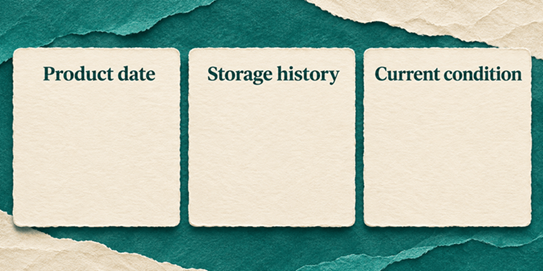
Date, storage history and present condition provide different information.
What a two year aging study actually found
Page and colleagues’ 2025 study examined 20 flavoring chemicals in reference liquids and 14 commercial liquids over 24 months. It compared room-temperature light exposure, room-temperature darkness and cold darkness. Flavoring stability varied; light-exposed room-temperature samples generally showed the greatest instability.
The commercial liquids were removed from cartridges and transferred into laboratory tubes, and their manufacturing age before purchase was unknown. Thus, the experiment did not test every unopened retail package or establish a fresh-to-expired timeline for all products.
The observation period is not a recommended shelf life. A study lasting 24 months does not mean that every liquid is suitable until that point or becomes unsuitable at the next moment. Its design and measured outcomes determine what can be concluded.
Appearance and chemical measurements answer different questions
The same aging paper measured nicotine concentration only at baseline, while following flavoring stability over time. Its findings therefore should not be converted into a schedule of nicotine strength remaining at each age. A flavor change and a nicotine-content measurement are different observations.
Looking at a bottle cannot recreate a chemical analysis. A darker appearance does not identify all the substances present, while an unchanged appearance does not supply evidence that nothing changed. Preserve an observation as an observation instead of treating it as a pass or fail test.
Likewise, do not vape a questionable liquid to determine its age or safety from taste. The result would still be a sensory impression, with the same unanswered questions about the product’s history and actual composition.
Match storage to the product and keep containers secure
FDA advises keeping e-liquids in their original containers, securing caps, and storing them out of the reach and view of children and pets. These precautions concern accidental exposure. A convenient storage location must also preserve the product’s identity and meet its own directions.
Follow the exact label’s storage requirements. Do not transfer liquid into food or drink containers, decant it to imitate a research setup, or put a battery-containing device into a refrigerator because an experiment stored laboratory samples cold.
Die study’s cold-dark condition improved stability for some measured flavorings, but it did not demonstrate a home treatment that reverses aging. A laboratory condition is not a universal storage instruction for every bottle, pod or complete device.
Retain original containers and product details when requesting storage guidance.
If the actual directions are missing or unclear, ask for the specification for that formulation and package. Avoid replacing missing instructions with an arbitrary temperature, freezer routine or instruction borrowed from a different product.
Separate opened liquid from the complete device
Opening a container creates a useful date to record; it does not reset the product’s manufacturing history. Conversely, a sealed package does not tell you everything about conditions before it reached you. Neither description removes the need for the actual manufacturer’s requirements.
Unser Erläuterung zum Verfallsdatum von Einwegartikeln covers the broader device question. Battery condition and the intended endpoint of a sealed product are separate from the chemical aging of liquid. Do not extract liquid from a disposable to examine, save or transfer it.
Volume estimates answer a different time question again. Our 100 ml supply-duration guide concerns how long an available volume might last under stated assumptions. A calculated usage duration does not extend a manufacturer’s date or show that the remaining supply is suitable.
Resolve uncertainty without trying to restore the liquid
Retain the exact product, batch, printed date and known storage events. Describe any damaged packaging, leakage or unexpected change without inventing its chemical cause. Ask the manufacturer whether its directions still apply given that history.
Do not combine old and new supplies to make a date problem disappear, or add ingredients to mask a changed appearance or flavor. Deliberate heating, airing or repeated use is not a dependable assessment or restoration method.
If product identity or applicability cannot be clarified, do not assume continued use is justified. Seek an appropriate disposal route for the actual liquid or complete device and its condition. Keep liquids secured while resolving the question; uncertainty about age does not remove the need to prevent accidental exposure.
Häufig gestellte Fragen
Does all e liquid last two years
No universal period follows from the cited study or a familiar rule of thumb. Use the exact product’s date meaning and storage directions.
Can an unopened bottle last indefinitely
An unopened state does not establish an unlimited life or a known storage history. The manufacturer’s requirements still matter.
Does a color change prove the liquid is unsafe
Color alone cannot identify composition or quantify risk. An unchanged color also cannot certify suitability. Clarify an unexpected change rather than taste-testing it.
Can refrigeration restore an old liquid
The study did not establish a reversal treatment. Do not improvise refrigeration or freezing for an unidentified product or a battery-containing device.
Is aged liquid always weaker in nicotine
Do not infer nicotine concentration from age, appearance or flavor. The cited flavoring study did not measure nicotine changes throughout storage.
What if I cannot interpret the batch date
Keep the original label and ask the manufacturer about that exact code and product. Do not substitute a guessed date or another brand’s coding system.
Quellen und weitere Informationen
Source check date: November 5, 2026. Research observations do not define a universal shelf life or prove that aged liquid is safe. FDA guidance concerns accidental-exposure prevention in the US. No product was chemically analyzed or tested for this article.
 Vapes mit 9.000 Zügen
 E-Zigaretten mit 12.000 Zügen
 E-Zigaretten mit 15.000 Zügen
 E-Zigaretten mit 20.000 Zügen
 E-Zigaretten mit 30.000 Zügen
 E-Zigaretten mit 40.000 Zügen
 E-Zigaretten mit 50.000 Zügen
 E-Zigaretten mit 60.000 Zügen
 E-Zigaretten mit 80.000 Zügen
 E-Zigaretten mit 100.000 Zügen