







Blog
How Long Should a Disposable Vape Last You

A disposable vape has no fixed lifespan in days. How long it lasts depends on the exact model, how frequently it is used, draw length, operating mode, and whether its battery can be recharged. A number such as “5,000 puffs” does not promise a week, a month, or any other calendar period.
For adult users assessing a device they already have, the useful questions are whether its liquid is depleted, whether only the battery needs charging, and whether it has developed a fault. Your own history with the same model can help estimate duration. A burnt taste, leakage, or abnormal operation is a reason to stop, even if the device has delivered fewer puffs than advertised.
What Disposable Vape Lifespan Means
People use “last” to describe several different things. Separating them prevents a low battery from being mistaken for an empty device, or a storage date from being mistaken for a promise of months of use.
- Total usable life is the period before the sealed device reaches the end of its liquid supply or otherwise becomes unusable.
- Battery runtime is the period before the battery needs charging, where the model is designed to recharge.
- Shelf life concerns the product’s age and storage conditions, including any date printed on its packaging.
A rechargeable disposable can run out of battery while liquid remains. Conversely, a charged battery does not establish that usable liquid remains. A reusable device with replaceable pods introduces another distinction: the life of one pod is separate from the life of the device. Check the exact product type rather than relying on a familiar brand name.
The ELFBAR support page, for example, identifies the BC10000 as rechargeable while liquid remains, with disposal required once its liquid is exhausted. That is a model-specific explanation, not a charging rule for every disposable.
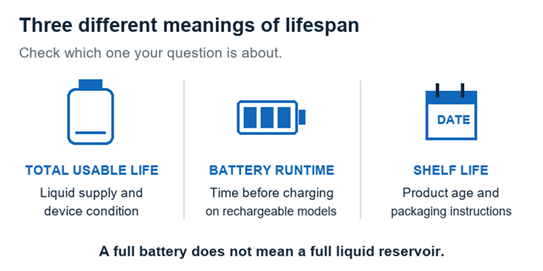
Total usable life, battery runtime, and shelf life describe different limits.
Why Advertised Puff Counts Do Not Guarantee Days
A puff count needs a test method to have meaning. Vuse’s puff count methodology describes machine testing with consistent puff parameters and a one-second duration for its consumer puff figures. It also explains that the result is averaged across tested samples. These are the company’s testing conditions, not a universal description of how people use every vape.
ELFBAR’s official lifespan explanation likewise says its laboratory figures use one-second draws and that actual counts vary with use. Longer draws can therefore make a device reach its endpoint before the user has counted the number printed on the box. Do not assume an exact proportional conversion from draw length alone.
Operating mode also matters. The official GEEK BAR PULSE page lists 15,000 puffs in Regular mode and 7,500 in Pulse mode for its Standard Version. This shows why the mode attached to a claim matters. Those figures are manufacturer ratings, not independently verified calendar lifespans or recommendations to use either mode.
When checking a label, read the small print for the named model, version, mode, and testing conditions. Two large numbers on different boxes may represent different assumptions. Neither number tells you how many puffs you personally take each day.
How to Estimate How Many Days a Device May Last
The basic calculation is estimated usable puffs divided by usual puffs per day. Both inputs need a reasonable basis. If the only available total is a laboratory rating, the result remains a conditional calculation rather than a reliable prediction.
The following table assumes a hypothetical device actually delivers 2,000 usable puffs. It illustrates the arithmetic only. The daily counts are invented examples, not measured user averages or recommended amounts of nicotine use.
| Assumed usable total | Hypothetical daily count | Calculated duration |
| 2,000 puffs | 100 puffs per day | 20 days |
| 2,000 puffs | 200 puffs per day | 10 days |
| 2,000 puffs | 400 puffs per day | 5 days |
If the real total is lower, the calculated duration falls. If daily use varies, the result varies too. The table does not establish how long a particular 2,000-puff product will last, and it is not a target to reach before discarding a faulty device.
For an existing user, previous elapsed time with the same model may be more practical than counting every draw. Record when use began, when the device reached its endpoint, the mode, and whether the ending appeared to involve liquid, battery, or a fault. Count elapsed time consistently; Friday evening to Monday evening is three days.
As a hypothetical example, three devices reaching their normal endpoints after three, four, and five days give a four-day average and a three-to-five-day observed range. That describes only those examples. Exclude a leaking or defective unit from a normal-lifespan estimate, while keeping its details for a support inquiry. Do not prolong use simply to complete a record.
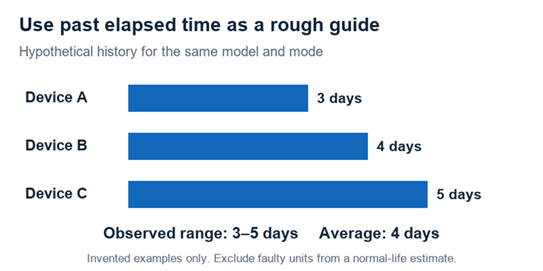
An illustrative history can show a range. These invented values are not performance test results.
Factors That Change the Estimate
Frequency and Draw Length
Calendar duration depends on how use is spread over time. A device used intermittently and the same device used frequently do not have the same timetable. Draw length adds another variable because a counted puff is not necessarily equivalent to the draw used in laboratory testing.
This is why vague categories such as “light” and “heavy” use are weak forecasting tools unless the source defines them. Someone else’s report that a device lasted a week does not tell you their draw duration, daily count, or mode. It also does not establish that your device is defective if yours ends sooner.
Model and Operating Mode
Use information for the exact version. A different liquid capacity, power setting, or device design can make a comparison inappropriate. More milliliters alone do not provide a universal puff conversion, and a puff figure for one mode should not be applied to another.
Liquid capacity and battery capacity also describe different resources. Milliliters describe liquid volume; milliamp-hours, abbreviated mAh, describe battery charge capacity. Neither specification alone supplies the daily-use information needed to calculate calendar duration. Avoid treating a larger number in one column as a complete lifespan comparison.
Storage and Product Condition
Damage or unsuitable storage can interrupt use before normal depletion. The FDA’s vape battery guidance advises protecting devices from temperature extremes and following manufacturer care instructions. Keep the device away from direct sunlight and hot or freezing vehicles.
These precautions do not guarantee a particular number of days. A device that leaks or operates abnormally needs assessment regardless of its age. Do not heat, open, or modify a sealed device to try to recover remaining puffs.
Battery Runtime and Remaining Liquid
If a disposable stops producing vapor, first check its documented indicators. A blink or a percentage is only useful when you know what the manufacturer says it represents. Some devices distinguish battery and liquid status; others do not provide both.
For example, the GEEKBAR HERO instructions identify battery information on the right of its screen and a liquid indicator on the left. This layout applies to that model. Do not assume the same symbols or positions on a different device.
For a model designed to recharge, consult its instructions and our guide to how long to charge a disposable vape and when to unplug. Charging addresses battery depletion; it cannot replace used liquid. A non-rechargeable model should not be adapted for charging.
If liquid depletion seems more likely, see how to tell if your disposable vape is almost empty. Keep that check separate from the expected number of days. A device does not retain usable liquid merely because a calculation says it should.
Signs to Stop Before the Expected Endpoint
Do not continue through a burnt taste to reach an advertised count. Our guide to what to do when a disposable vape tastes burnt explains why charging cannot repair a damaged wick. An estimate never takes priority over the condition of the device.
LOST MARY’s current troubleshooting guidance advises stopping when a device leaks, spits unusual liquid, or activates by itself. It also says not to charge a leaking, damaged, overheating, or water-exposed device. These symptoms need appropriate support, rather than further use to test its lifespan.
For a support inquiry, keep the model name, purchase date, receipt, packaging, and a description of what happened. Describe “stopped producing vapor after two days” separately from “delivered fewer counted puffs than claimed.” They are different observations and may require different checks. Photos of the exterior and displayed message can help; opening the housing is unnecessary.
For disposal in the United States, the EPA recommends appropriate household hazardous waste collection for e-cigarettes. Keep devices out of household trash and ordinary recycling. Elsewhere, ask the local waste service which collection route accepts the complete device, especially if it is damaged.
Frequently Asked Questions
How many days should a disposable rated at 5000 puffs last
There is no guaranteed number. Dividing 5,000 by 200 gives 25 days mathematically, but only if both inputs describe actual use. A laboratory rating and an assumed daily count do not establish that a specific device will last 25 days.
Is a disposable that lasts only one day defective
One day alone does not prove a defect. Check the model, use pattern, battery status, and symptoms. Immediate failure, leakage, or abnormal operation warrants support regardless of the expected duration. Do not keep using it to collect more evidence.
Does recharging reset the available puff count
No. Recharging supplies battery energy to a model designed for it; it does not refill a sealed reservoir. Any counter or display reset should be interpreted using the model instructions, rather than treated as a new liquid supply.
Will a device rated at 15000 puffs always outlast one rated at 5000 puffs
The labels alone cannot establish that. Compare the exact models, test conditions, operating modes, and your use. A higher manufacturer rating is not a guarantee of a longer calendar lifespan under different conditions.
Does a liquid indicator at half mean half the days remain
It does not give a dependable day count by itself. You still need to know what the indicator measures and how future use compares with previous use. Do not extend a calculation past a burnt taste or other stop-use sign.
How long does an unopened disposable vape last
Use the date and storage instructions on its actual packaging. An unopened product’s age is a different question from duration after use begins. Ask the manufacturer if the date is missing or unclear; do not assume one shelf-life period applies to every model.
Should I keep using it until the advertised puffs are reached
No. Stop when the device is empty, tastes burnt, leaks, or develops a fault. A printed puff figure does not override those signs. Contact support for a suspected problem and follow local disposal instructions when the device is finished.
Sources and Further Information
Official manufacturer and public safety sources checked October 14, 2026. Manufacturer examples describe the named models and versions; they are not independent performance tests or statements of local product authorization. EPA disposal guidance applies to the United States.
- Vuse UK — Puff Count Methodology.
- ELFBAR — Official Support and Model FAQs.
- GEEK BAR — PULSE Standard Version.
- FDA — Tips to Help Avoid Vape Battery Fires or Explosions.
- GEEK BAR — HERO User Instructions.
- LOST MARY — Why Is My LOST MARY Not Working, published August 26, 2026.
- EPA — How to Safely Dispose of E-Cigarettes, updated January 30, 2026.
 9000 Puff Vapes
 12000 Puff Vapes
 15000 Puff Vapes
 20000 Puff Vapes
 30000 Puff Vapes
 40000 Puff Vapes
 50000 Puff Vapes
 60000 Puff Vapes
 80000 Puff Vapes
 100000 Puff Vapes