







Blog
How to Tell If Your Disposable Vape Is Almost Empty

A disposable vape may be almost empty when its flavor stays weaker than usual and vapor output remains low despite adequate battery charge. A low liquid indicator or a visibly low reservoir can add evidence, if your model has those features. A burnt taste is a reason to stop using it, but it does not prove that every drop of liquid is gone.
The useful distinction is between low e-liquid, low battery power, and a device fault. Their symptoms overlap, so no single blink, taste change, or puff count gives a reliable answer for every model. This guide helps adult users decide when to check the instructions, recharge an appropriate device, or stop using it. FDA information on e-cigarettes explains that these products are not risk-free and that nicotine is addictive.
Signs that your disposable vape may be running low
A lasting change from the same device’s normal performance is more useful than comparing it with another model. Notice whether the flavor has become consistently less distinct and whether normal draws produce less vapor. Those changes can suggest reduced liquid supply, but they can also occur with low battery power or a worn heating system.
Look for a second clue before deciding that the reservoir is nearly empty. If the battery has sufficient charge but performance stays poor, low liquid or a coil problem becomes a more plausible explanation. If the device has an intended viewing window, inspect it without opening the casing. Follow the manufacturer’s guidance for interpreting the visible level.
There is no need to wait for a burnt hit. Stop when the device no longer performs normally and the permitted checks do not resolve the problem. You do not need to establish an exact remaining percentage to make that decision.
Low liquid and low battery require different decisions
The battery supplies energy; the reservoir supplies e-liquid. Charging can restore available power in a rechargeable model, but it cannot replace liquid or repair a damaged coil. The table below compares possible explanations rather than diagnosing the device from a single symptom.
| What you notice | Possible explanation | Appropriate next step |
| Weak flavor and reduced vapor with adequate charge | Low liquid or a coil problem | Check any documented liquid indicator; stop if normal performance does not return |
| A documented low battery signal without burnt taste or damage | Low battery charge | Recharge only if the model is designed for charging |
| Burnt taste even though the display shows charge or liquid | Insufficient liquid reaching the wick or a damaged heating system | Stop using the device; do not repeat test puffs |
| Leakage, swelling, unusual heat, or self-activation | A possible fault | Stop using and charging it; seek manufacturer or seller support |
Innokin’s troubleshooting guidance identifies battery charge and coil condition among possible reasons for poor vapor production. Its tank maintenance instructions should not be applied to a sealed disposable.
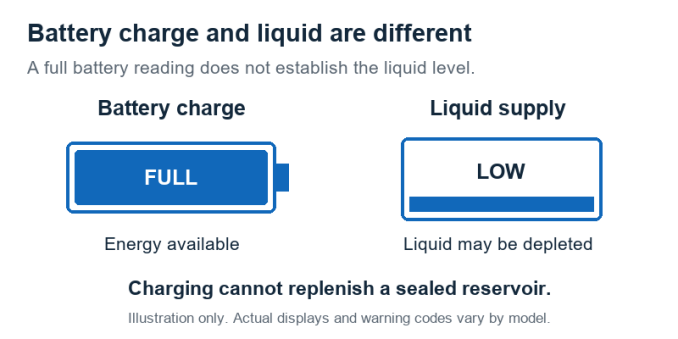
Check for warning signs before considering a recharge.
A practical check before you recharge or replace it
Start with the device’s condition, then its documented indicators. A charging cycle may take longer than a quick inspection, so this is a decision sequence rather than a timed test.
- Pause use. If the device is unusually hot, leaking, damaged, swollen, or activating by itself, stop here. Do not charge it.
- Identify the exact model and read its instructions. Confirm whether charging is supported and what the light or screen means.
- Inspect the exterior and charging port without dismantling anything. Check for visible obstruction at the mouthpiece or air inlet; do not insert sharp objects.
- If low battery is indicated and the device is rechargeable and undamaged, follow its charging instructions. Use the specified cable and compatible power source.
- After charging, disconnect it and check the documented status. If there has been no burnt taste, leakage, damage, or abnormal heat, assess its performance during normal use. Stop immediately if an abnormal taste or condition appears.
If a permitted charge restores normal performance, low battery was a likely immediate cause. If weak output or poor flavor continues, further charging is not a useful way to investigate low liquid. A sealed device may be depleted or faulty; contact support rather than opening it.
The FDA’s vape battery guidance recommends following the manufacturer’s instructions and charging on a clean, flat surface away from flammable materials, where the device remains visible. Avoid charging in extreme temperatures or continuing after the specified charging process is complete.
What the light or screen actually tells you
A blinking light is a status signal whose meaning depends on the model. Check the documented pattern instead of assuming that every flash means the reservoir is empty.
- A battery symbol refers to electrical charge. A full battery can coexist with depleted liquid.
- A liquid symbol refers to the manufacturer’s liquid-level indication. Check whether the manual describes a measured level, an estimate, or a simple warning.
- A viewing window allows a visual check of the accessible reservoir. It does not verify the condition of the internal wick or coil.
- A puff counter records the information defined by the manufacturer. Do not assume it measures remaining liquid directly.
Innokin’s explanation of disposable indicators describes approximate liquid meters on some devices. That does not establish how the display on a different brand or model works. Avoid applying one manufacturer’s colors, percentages, or blink counts to another product.
If the screen appears reassuring but the device tastes burnt or develops a fault, stop using it. The display is an aid to interpretation, not permission to continue through an abnormal condition.
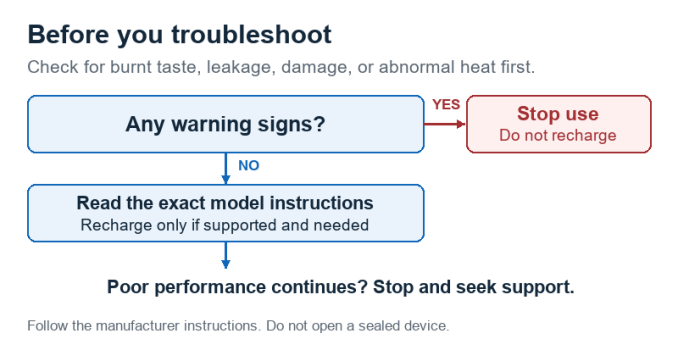
Illustrative status levels show why battery charge and liquid supply must be assessed separately.
Why the advertised puff count is not a countdown
An advertised puff figure is not an exact promise of how many draws an individual user will receive. Draw length and the test method matter. Without a documented method for the exact model, you cannot convert its headline puff count into reliable days of use or a precise remaining percentage.
For example, two users recording the same number of draws may not have used the device in the same way. Keeping track of the start date can help with personal planning, but it does not establish how much liquid is left. Do not continue using a poorly performing device merely because your count is below the number on its packaging.
A burnt taste does not always mean an empty reservoir
A wick carries liquid to the heating element. When too little liquid reaches it, heating can produce a burnt taste. Low liquid is one possible cause; coil wear and insufficient time for the wick to resaturate can also contribute. Vuse’s explanation of burnt taste distinguishes these causes.
This matters because visible liquid does not make a burnt-tasting device suitable for continued use. With a sealed disposable, you cannot inspect or replace the internal heating system as you would with a serviceable tank. Do not try repeated draws, extra charging, or stronger inhalation to clear the taste.
When to stop using the device immediately
Stop using and charging a device that becomes unusually hot, changes shape, leaks, produces an unusual odor, or makes unexpected noises. Swelling and self-activation should be treated as possible faults rather than signs that it is simply running low.
The NFPA lithium-ion battery safety sheet lists excessive heat, shape changes, leakage, odor, and odd noises as reasons to stop using a battery. If there is smoke or fire, move away and contact local emergency services. Do not try to dismantle the device.
If a new device behaves abnormally, contact the seller or manufacturer with its model name, purchase details, and photos if safe to obtain. LOST MARY’s support guidance advises against charging damaged or leaking devices and against opening or attempting to repair them. Use the support instructions for your own model; a fault early in use should not automatically be labeled ordinary depletion.
What to do with an empty disposable vape
Keep the device intact and away from children and pets. Do not pry open the casing to inspect the liquid, remove an integrated battery, or add liquid to a product that is not designed to be refilled. If a manufacturer provides an intended removable component, follow those specific instructions rather than improvising.
In the United States, the EPA recommends taking e-cigarettes to a household hazardous waste collection site. Its guidance says not to put them in household trash or ordinary recycling because lithium batteries can cause fires and residual nicotine presents a chemical hazard.
Elsewhere, ask your local waste authority or an authorized collection service which route accepts complete vape devices. Confirm acceptance before dropping one off. Tell the service if the device is damaged or leaking, since handling arrangements may differ. An empty reservoir does not mean the battery or any nicotine residue has ceased to be a disposal concern.
Frequently Asked Questions
What is the clearest sign that a disposable vape is almost empty
A sustained decline in flavor and vapor with adequate battery charge can suggest low liquid. A documented low liquid indication adds evidence. No symptom establishes an exact remaining quantity, and a burnt taste is a reason to stop rather than test further.
Does a blinking light mean the vape has run out of liquid
Not necessarily. Read the guide for the exact model and blink pattern. A documented battery warning and a liquid warning require different responses; there is no universal color code for all disposables.
Can the battery be full when the e-liquid is empty
Yes. Charge and liquid supply are separate. A full battery indicator does not confirm that the wick is receiving liquid, and another charge cannot replenish a sealed reservoir.
Why does the vape taste burnt while liquid still appears to remain
Liquid may not be reaching the wick properly, or the heating system may be worn or damaged. Visible liquid does not rule out those problems. Stop using a burnt-tasting sealed device and seek support if it is unexpectedly new.
Should I recharge a disposable that produces no vapor
Only if its instructions confirm that it is rechargeable, it indicates low battery, and it has no warning signs. Do not charge a leaking, damaged, unusually hot, or burnt-tasting device as a troubleshooting experiment. Persistent failure requires support or appropriate disposal.
Can I refill or open it to get the remaining liquid
Do not open or refill a sealed model that is not designed for those actions. Follow the manufacturer’s intended replacement or refill procedure only for products that explicitly support it. A charging port alone does not establish refillability.
Can I put an empty disposable vape in a recycling bin
Do not place the complete device in ordinary mixed recycling. In the United States, follow EPA household hazardous waste guidance; in other locations, confirm an appropriate vape collection route with the local waste authority.
Sources and Further Information
Sources reviewed and links accessed on October 8, 2026. Manufacturer guidance supports technical explanations and does not certify another brand’s specifications or safety. FDA, EPA, and NFPA sources are U.S. references; local disposal arrangements must be checked separately.
- FDA — E-Cigarettes Vapes and Other Electronic Nicotine Delivery Systems. General product and nicotine risk information.
- FDA — Tips to Help Avoid Vape Battery Fires or Explosions. Charging precautions and manufacturer instructions.
- EPA — How to Safely Dispose of E-Cigarettes. U.S. household hazardous waste collection advice.
- NFPA — Lithium-Ion Battery Safety. Battery warning signs and handling precautions.
- Innokin Support — Troubleshooting. Battery and coil explanations for reduced vapor; serviceable tank instructions are not disposable repair instructions.
- Innokin — How to Know When Your Disposable Vape Is Almost Empty. Examples of approximate liquid displays and the limits of puff estimates.
- Vuse — Why Does My Vape Taste Burnt. Liquid delivery and coil explanations for burnt taste.
- LOST MARY — Common Issues and Support Guide. Model-specific troubleshooting boundaries and reasons to seek support.
 9000 Puff Vapes
 12000 Puff Vapes
 15000 Puff Vapes
 20000 Puff Vapes
 30000 Puff Vapes
 40000 Puff Vapes
 50000 Puff Vapes
 60000 Puff Vapes
 80000 Puff Vapes
 100000 Puff Vapes
3 thoughts on “How to Tell If Your Disposable Vape Is Almost Empty”