







Blog
Disposable Vape Waste and Recycling Limits

A disposable vape becomes a waste-management problem because one small item combines different materials, a battery and potentially residual liquid. Collecting it is an important first step, but collection does not prove that every material will be recovered. The receiving service must be equipped to accept and manage the complete product and its condition.
For adults with existing devices, understanding that combination helps explain why a plastic-looking case does not belong automatically in plastics recycling and why a battery collection point may need more information. This article explains the treatment problem, without instructions for dismantling or separating a device at home.
One product contains several different material groups
Turner and colleagues’ 2024 original study characterized nine types of spent disposable vapes sourced in the United States. It identified combinations of polymers, metal parts, batteries and electronic components. Material contributions differed between the sampled products.
That variation matters. The outside surface cannot establish the composition of the complete object, and a result from one sampled device is not a specification for all disposables. Nor does a material study establish the recycling performance of every local collection system.
Il Scottish Government’s environmental assessment also describes single-use vapes as a combination of casing, mouthpiece, filler, heating components, battery and other electronics. A general component list is useful for understanding the mixed waste stream, rather than identifying parts an owner should remove.
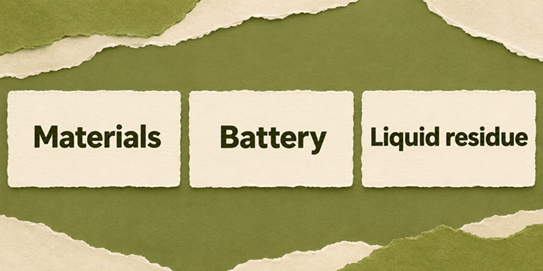
One intact product can involve several different treatment concerns.
The central difficulty is the assembled product. Knowing that individual materials have recycling uses does not establish that the assembled item can enter the same process as a clean, separated material.
Why ordinary waste handling creates additional problems
EPA advises US individuals against putting e-cigarettes in household trash or ordinary recycling. Its explanation identifies lithium-battery damage and fire risk, alongside nicotine risks to workers and the environment. These are different concerns within the same waste item.
A sorting decision based only on the visible casing misses the battery and any remaining liquid. Similarly, treating the product as an ordinary empty container does not demonstrate that its internal contents are absent.
An item no longer producing aerosol should not be treated as a certificate of electrical or chemical emptiness. Do not repeatedly activate it to make it seem depleted before collection. Its actual condition is information the receiving service needs, not a problem to hide through further use.
Separation is a treatment task rather than a household shortcut
Il material and elemental analysis describes complex combinations of plastics, metals, circuitry and batteries in the sampled devices. The investigators’ laboratory characterization was research work. Its dismantling and sample-preparation methods are not instructions for owners preparing waste.
For a treatment service, identifying a recoverable material and obtaining an acceptable separated stream are different tasks. The service also has to account for the rest of the product. A description such as metal case does not resolve how the attached electrical and liquid-bearing components will be managed.
| Concern in the complete item | Why the outside is insufficient | Question for the receiving service |
| Mixed materials | Casing does not identify all components | Do you accept whole devices |
| Embedded battery | Appearance does not establish condition | How should this condition be reported |
| Liquid residue | Finished use is not a residue analysis | Does your route handle nicotine devices |
Keep a sealed device assembled. Do not extract a cell, rinse internal parts, drain liquid or cut the housing to make it look easier to recycle. Those actions change the handling problem without establishing that the resulting pieces have a suitable receiving route.
Collection and recovery describe different outcomes
Collection records that a service received an item. Recycling concerns processing a material into a usable material stream. Other treatment may manage hazards without returning every component as recycled material. These descriptions should not be substituted for one another.
Ask what a claim measures. Does a reported figure concern whole items accepted, their total mass, a particular battery or metal fraction, or material actually recovered? Without that boundary, a large collection total cannot establish a recovery percentage.

Confirm what the receiving service accepts and what happens after collection.
The absence of a clear public recovery figure is a reason to avoid inventing one. It is not proof that every component is recovered, nor proof that all specialized collection is pointless. Managing hazards and recovering materials are related goals with distinct evidence requirements.
Consider the wider resource boundary
The Scottish environmental assessment discusses material assets, life-cycle emissions and the waste hierarchy. Its discussion places reducing waste generation ahead of relying entirely on improved recycling. This is an environmental-assessment context, not a product-specific carbon certificate.
A collection claim addresses an endpoint. It does not independently account for extracting materials, manufacturing the device, transport or the treatment process. A complete environmental comparison would need a stated system boundary and comparable assumptions for those stages.
Likewise, the nine-device material study is not a complete life-cycle assessment. It characterizes physical and elemental composition; it should not be turned into a universal carbon footprint or a ranking of all disposable and reusable products.
What an existing owner can clarify
For US household waste, EPA recommends a household hazardous-waste collection route and contacting the local solid-waste agency. Confirm acceptance of the complete nicotine-containing device and explain its actual condition before taking it anywhere. Other countries and business-generated waste have their own arrangements.
Il nostro whole-device disposal guide develops the receiving-route questions. The rechargeable and non-rechargeable comparison addresses a separate electrical permission: supporting charging does not make the product free of eventual waste.
Il nostro maintenance and device-limits comparison explains which tasks different designs permit. It does not authorize home separation of sealed equipment for recycling. Keep product identity and condition with the inquiry so the service can give an applicable answer.
Domande frequenti
Can a disposable go in ordinary recycling
EPA advises US individuals against household trash and ordinary recycling for e-cigarettes. Confirm a route that accepts the complete product.
Does a flat battery remove the waste problem
No. An operational endpoint does not establish the complete item’s electrical or chemical condition, and the mixed materials remain.
Does recyclable mean every part is recovered
Not automatically. Ask which material, process and actual outcome the claim describes.
Does every battery collection point accept whole vapes
Do not assume that. Confirm complete-device and nicotine-product acceptance with the receiving service.
Does a metal case make the whole device scrap metal
The casing does not identify or separate the battery, electronics and other contents. Keep sealed equipment assembled.
Does recharging make a disposable waste free
No. Charging concerns battery energy, while the complete product still has an endpoint and treatment needs.
Fonti e ulteriori informazioni
Source check date: November 6, 2026. EPA guidance cited here concerns US individuals. Scottish assessment material provides environmental context, not a current worldwide legal summary. The research sample is not every model or a full life-cycle assessment. No dismantling, recovery test or waste-service audit was performed for this article.
 Sigarette elettroniche da 9000 boccate
 Sigarette elettroniche da 12.000 boccate
 Sigarette elettroniche da 15.000 boccate
 Sigarette elettroniche da 20.000 boccate
 Sigarette elettroniche da 30.000 boccate
 Sigarette elettroniche da 40.000 boccate
 Sigarette elettroniche da 50.000 boccate
 Sigarette elettroniche da 60.000 boccate
 Sigarette elettroniche da 80.000 boccate
 Sigarette elettroniche da 100.000 boccate