






Blog
Hoe wegwerpvapes op de juiste manier af te voeren

To properly dispose of a disposable vape, arrange collection for the complete device through a program that accepts its battery and remaining liquid. For US households, the De EPA beveelt de inzameling van gevaarlijk huishoudelijk afval aan, rather than putting vapes in household trash or ordinary recycling. Keep a sealed device assembled and confirm the receiving program’s instructions before you prepare it for drop-off.
The first decision concerns its condition. An intact unwanted vape, a leaking or damaged vape, and a device showing signs of active battery failure need different responses. This guide covers household nicotine-vape waste in the United States. Collection arrangements elsewhere, and those for business or cannabis waste, require separate checks.
Why an Empty Vape Still Needs Separate Collection
A vape can stop producing vapor without becoming an ordinary piece of empty packaging. Its battery remains part of the waste stream, and a nicotine-containing device can also retain liquid. EPA identifies both battery fires and nicotine exposure as reasons for separate collection.
An unlit screen does not prove the battery contains no energy. The EPA’s used household battery guidance explains that used batteries can still have enough energy to cause injury or a fire even when they appear discharged. Do not use repeated puffs or improvised electrical connections to try to make a device safe for the bin.
If an intact device’s status is unclear, our guide to recognizing an almost empty disposable vape helps distinguish liquid depletion from battery status. That distinction can explain why it stopped working; it does not change the disposal route for an unwanted sealed unit.
Check Its Condition Before Making a Collection Plan
Observe the exterior without opening the casing or testing a damaged device. Describe anything unusual when contacting the collection operator. Do not classify a vape as intact simply because it is no longer warm or because a visible leak has been wiped away.
| What you observe | Next action | What to avoid |
| Intact unwanted device with no apparent damage | Confirm a whole-device collection route | Trash, curbside recycling, or an unconfirmed battery box |
| Leaking, cracked, swollen, or otherwise damaged device | Disclose the condition and obtain specific handling instructions | Treating it as a routine intact-device drop-off |
| Smoke, fire, or signs of active battery failure | Keep your distance and seek an emergency response | Bagging it, carrying it away, or driving it to a collection site |
Local restrictions can be stricter than the general description “vapes accepted.” San Francisco Environment, for example, excludes damaged, swollen, defective, or recalled batteries from standard drop-off sites and directs residents to a different service. That example does not establish a pickup entitlement outside San Francisco.
If a lithium-ion battery fire occurs, the De Amerikaanse brandweer raadt aan te evacueren en 911 te bellen. An active incident needs an emergency response before any disposal appointment is considered.
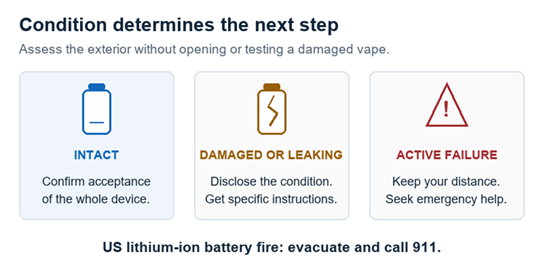
Assess condition before making a routine collection plan. Active battery failure is not a drop-off task.
Find a Program That Accepts the Whole Device
Start with your city or county’s official household hazardous waste page. “Household hazardous waste,” often shortened to HHW, is a useful search term alongside your location and “nicotine vape.” If the page lists batteries or electronics without mentioning vapes, contact the solid waste agency or operator for clarification.
A retailer or manufacturer may identify another collection route. Confirm that the actual program accepts complete disposable nicotine vapes, rather than assuming that a battery recycling logo or a counter selling vapes establishes acceptance.
Veelgestelde vragen over The Battery Network illustrates the distinction: its collection program excludes vapes whose batteries cannot be removed and fully separated. This restriction is a reason to find an appropriate whole-device service. It is not an instruction to force a built-in battery out so the vape can qualify for a battery box.
Keep the source of the instructions clear. A locator can identify a possible destination; the receiving operator confirms whether that destination accepts your particular item and condition. Save the current instructions or appointment confirmation so you can follow them accurately.
Confirm Acceptance Before Preparing a Trip
A brief conversation can prevent arriving with an item the site cannot handle. Describe the product as a whole disposable nicotine vape with an embedded battery, mention whether liquid remains, and disclose any damage before discussing packaging or transport.
Ask the operator:
- Does this location accept the complete device, including residual liquid and the built-in battery?
- Is the service for residents, and what proof of eligibility is required?
- Are appointments, particular collection days, quantity limits, or fees involved?
- Does its condition require a separate service or different preparation?
- How should an accepted intact device be protected and presented at handover?
A useful opening is: “I have three household disposable nicotine vapes with built-in batteries. They appear intact, and some may still contain liquid. Do you accept them as whole devices, and what should I do before bringing them?” Change the description if one leaks or has been opened.
Acceptance conditions vary. Clark County, Washington, lists a household route for whole nicotine-vape devices with or without liquid, with a one-gallon limit per visit. Its residential arrangements exclude business-generated vape waste and cannabis devices. These are local conditions, not a nationwide acceptance policy.
If you are redirected, ask which agency or operator can advise on complete vapes. Repeating the specific description is more useful than asking only where “batteries” go.
Prepare Only as the Receiving Program Directs
Keep the Sealed Unit Intact
Do not open a disposable to drain liquid or extract an embedded battery. The EPA’s e-cigarette collection tip sheet warns against removing embedded batteries or cartridges and pouring nicotine liquid down a drain. That page addresses collectors; its business storage and shipping procedures are not a universal household packing checklist.
For an accepted intact vape, follow the receiving site’s directions about individual protection, containers, power controls, and handover. Use a power-off control only if the exact device has one and its instructions explain it. Do not create a switch by disturbing the internal wiring.
Limit Unnecessary Handling While You Wait
Arrange collection rather than leaving unwanted devices to accumulate. Keep intact units out of reach of children and pets, and follow the manufacturer’s storage instructions. The Richtlijnen van de FDA inzake batterijen voor e-sigaretten advises protecting devices from extreme temperatures, including a hot car or direct sunlight. Waiting for collection is not a reason to recharge or test an unwanted unit.
For a leaking or damaged device, obtain instructions for that condition before choosing a container or making a trip. Instructions intended for an ordinary intact vape should not be treated as a way to contain an actively failing battery.
Avoid contact with exposed liquid. The FDA’s e-liquid guidance says to wash affected skin thoroughly with soap and water after accidental contact. That advice concerns skin exposure; it does not mean rinsing a vape or pouring its contents into a sink.
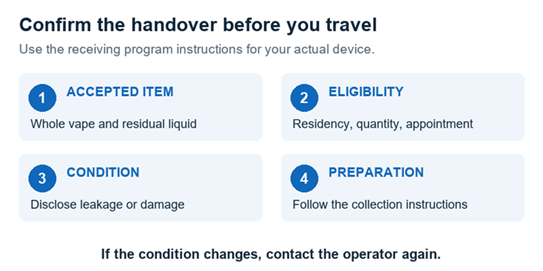
Confirm acceptance, eligibility, condition and preparation before an agreed drop-off.
Complete the Handover and Plan for Future Devices
Before an agreed drop-off, check that the appointment, location, quantity, and condition description are still accurate. If a device has begun leaking or has been damaged since the operator gave instructions, contact them again. Do not leave vapes beside a full collection box or outside a closed site.
At handover, tell the attendant what the items are and disclose any condition that affected the collection arrangement. Let the program determine the appropriate treatment. Acceptance does not itself promise that every material in every device will be recycled.
For future unwanted units, retain the confirmed program details and check them again before another trip. Do not turn a drop-off arrangement into an improvised mail-back service; a parcel needs an actual program’s approval and instructions.
If an intact device is being discarded solely because it will not produce vapor, the no-hit troubleshooting guide may help identify a documented external check. There is no need to finish the remaining liquid or attempt a repair before arranging disposal.
Veelgestelde vragen
Can I Dispose of an Unused Disposable Vape
Yes. Tell the receiving program that it is unused and contains liquid. Do not use it up or empty it before asking about whole-device acceptance. Keep the original product information available to describe it accurately.
Does Nicotine Free Mean It Can Go in the Trash
No. A nicotine-free label does not remove the battery from the device. Confirm the appropriate collection route for the complete product instead of treating nicotine content as the only disposal consideration.
Is Household Collection Always Free
Do not assume it is. EPA says household hazardous waste collections are typically free for residents, but eligibility, quantities, and local arrangements need confirmation. Ask about charges when booking rather than after arriving.
Can I Use a Medicine Take Back Box
Do not assume a medicine collection point accepts a vape with a battery. Ask about the complete device specifically. Clark County’s published medicine-event route refers to a device without its battery; that does not authorize opening a sealed disposable to use it.
Can a Shop Use the Same Household Drop Off
Not automatically. A household appointment is not confirmation that the site accepts commercial stock, customer collections, or waste generated by a business. The business should ask the appropriate waste agency about its own arrangements.
What If I Cannot Find a Nearby Site
Contact the local solid waste agency and manufacturer for guidance on whole devices and describe their condition. Do not substitute household trash, an unconfirmed battery bin, or a homemade shipping arrangement while looking for an accepted route.
Bronnen en aanvullende informatie
Sources checked October 20, 2026. This guide concerns US household nicotine-vape waste. Named local programs illustrate acceptance conditions; their services are not nationwide promises.
- EPA disposal information for individuals — household collection route, fire and nicotine hazards, and typical resident fees.
- Door de EPA gebruikte huishoudbatterijen — residual energy and limits of user battery servicing.
- San Francisco Environment vape disposal — local restrictions for damaged batteries and embedded battery removal.
- Richtlijnen van de Amerikaanse brandweer (US Fire Administration) inzake batterijen — US response to a lithium-ion battery fire.
- Veelgestelde vragen over het Battery Network — whole-vape exclusion where the battery cannot be separated.
- Clark County nicotine-vape disposal — local whole-device acceptance, quantity and waste-origin restrictions.
- Informatieblad van de EPA over het inzamelen van e-sigaretten — collector guidance on embedded parts and nicotine liquid.
- Voorzorgsmaatregelen van de FDA met betrekking tot batterijen voor e-sigaretten — manufacturer instructions and temperature precautions.
- Richtlijnen van de FDA inzake blootstelling aan e-vloeistof — accidental skin exposure and protection of children and pets.
 Vapes met 9000 trekjes
 Vapes met 12.000 trekjes
 E-sigaretten voor 15.000 trekjes
 E-sigaretten voor 20.000 trekjes
 Vapes met 30.000 trekjes
 Vapes met 40.000 trekjes
 Vapes met 50.000 trekjes
 Vapes met 60.000 trekjes
 Vapes met 80.000 trekjes
 Vapes met 100.000 trekjes
Eén gedachte over “How to Properly Dispose of Disposable Vapes”