







Blog
Advertised Vape Puff Counts vs E Liquid Capacity

An advertised vape puff count is a conditional performance claim; e-liquid capacity in milliliters is a volume specification. They describe different quantities. Neither number alone establishes days of use, nicotine absorbed or product quality. A useful comparison needs the exact model, operating mode and the method behind its puff rating.
For adults reading equipment specifications, begin by separating what the label states from what the manufacturer actually measured. More liquid can mean a larger supplied volume without establishing a fixed number of draws. Likewise, a larger printed puff count is not evidence that two products were tested in comparable ways.
Different numbers answer different questions
Milliliters, abbreviated ml, describe liquid volume. A puff count describes counted draws under some set of conditions. Battery capacity describes another resource again. Putting the numbers beside one another on a box does not create a universal conversion between them.
The distinction matters when comparing an entire disposable, one replaceable pod and a multipack. A headline number for a pack should not be treated as a rating for each individual unit. Read the small print identifying what is being counted before comparing large numbers on the front.

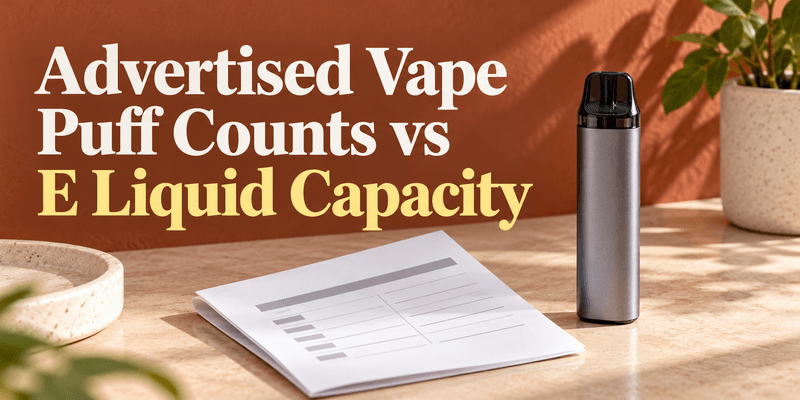
Puff counts and liquid volume describe different quantities; this is a conceptual illustration.
Liquid volume also differs from usable output. A nominal reservoir specification does not establish how much liquid reaches the heating area before the product’s intended endpoint. Nor does it show the quantity consumed in an individual draw. Those missing facts prevent a volume label from becoming a dependable puff forecast.
Keep the model and version with every figure you record. A shared brand, similar exterior or matching flavor name is insufficient to establish that two specifications describe the same device.
What the test method changes
Vuse’s published puff-count methodology describes machine testing, controlled draw duration and an endpoint based on aerosol output falling significantly. It reports averaging five samples. That is the manufacturer’s account of its method, not an independent test performed for this article.
The same page distinguishes a one-second consumer puff regime from a three-second analytical regime and publishes different counts for them. This illustrates the importance of test conditions. It does not establish the current version of an international standard, a universal method for all brands, or a direct conversion from any three-second count to a one-second count.
Another first-party example appears in ELFBAR’s support explanation of AF5000. The manufacturer associates its up-to-5,000 claim with one-second laboratory puffs and says actual counts vary with use. Keep that claim attached to the named model and stated condition.
Duration is only one comparison field. An endpoint, operating mode and whether supported recharging is included also affect what a reported total means. A test ending when a battery is depleted does not necessarily answer the same question as a test continuing through recharges until liquid depletion.
These methods are designed to produce repeatable information under specified conditions. A person’s draws can vary within one day. The gap between controlled conditions and variable use is a reason to qualify a forecast, rather than automatically declare every rating either accurate for everyone or fraudulent.
Read a real label without inventing a conversion
The official INNOBAR 6000 page advertises up to 6,000 puffs and separately lists 16 ml of liquid. Those are real published entries for that model. They are not measurements of a device inspected here or proof of current local availability.
Dividing one printed figure by the other would produce a numerical ratio of claims. It would not establish a physical constant that can be applied to another product. That would require comparable operating conditions and evidence about liquid use per draw and the endpoint.
For example, if two products heat different amounts of liquid during each draw, equal starting volumes need not yield equal counts. If their ratings use different draw durations, comparing the headline totals can conceal that difference. A mode change can also change the operating conditions without changing the stated starting reservoir volume.
Do not transfer the page’s marketing statements about days of use into a personal forecast. This article uses its specification fields as an example of two quantities, not as a recommendation or an independently verified endurance result.
Compare claims using the same information
Ask what information is available before choosing which number appears more persuasive. A meaningful comparison preserves the conditions instead of stripping them away to make a simple ranking.
| Detail | What to establish | Why it matters |
| Product identity | Exact model version and rated unit | A device, pod and pack are different units |
| Operating mode | The mode used for the quoted count | Other settings may change demand |
| Draw conditions | Duration and other disclosed parameters | Different regimes may yield different totals |
| Test endpoint | What event stops counting | Battery and liquid endpoints differ |
| Charging during testing | Whether it is included and supported | One battery charge may not be the whole test |
| Evidence behind the claim | Method and sample information | A headline alone leaves uncertainty |

Compare the actual model, duration and endpoint; these fields are not measured results.
If one manufacturer discloses a method and another does not, the missing information should stay visible. It is not appropriate to fill the gap with a method borrowed from a competing brand. Ask the second manufacturer to identify the relevant conditions.
You can still compare declared liquid volumes as volumes, provided the labels refer to the same type of supplied unit. That is narrower than concluding which device will deliver the most draws, last longest or provide a particular exposure.
Separate a rating from your own observations
An existing user’s experience can describe what happened with that item. It cannot automatically validate the laboratory claim or identify why a different result occurred. Record the exact model, mode, starting date and normal endpoint without turning an estimate into a target to reach.
Our guide to how long a disposable vape should last explains the separate elapsed-time question. Dividing an advertised count by an assumed daily count does not make either input a verified observation.
For a model designed to recharge, a battery warning may identify a supported charging task rather than liquid exhaustion. Our disposable charging guide explains the checks for that task. Recharging does not restore used liquid or reset the original claim into a fresh supply.
Stop ordinary use when the device is empty, persistently burnt, leaking or abnormal. Do not keep activating it to complete a tally, open the reservoir to measure residual liquid, or bypass a cutoff. A printed number cannot override the condition of the actual item.
What to do when information is missing
Send the manufacturer a complete label photograph and a precise question: which mode, draw duration, endpoint and recharge assumptions support this particular count? Ask whether the rating is per device, per pod or per pack. Request the model’s method rather than a generic assurance about the brand.
FDA recommends understanding manufacturer use and care directions and contacting the manufacturer when instructions are missing or unclear. Our actual-model instruction guide explains why similar names or controls do not resolve an identification gap.
Until the conditions are known, describe the number as the manufacturer’s advertised rating. Do not recast it as an observed result, a guaranteed personal lifespan or an amount of nicotine received.
Frequently asked questions
Is an up to puff figure a guaranteed minimum
No. Read the manufacturer’s specific method and conditions. The wording does not establish a minimum for every person’s variable draws or every device condition.
Does twice the liquid mean twice the puffs
Not from volume alone. Liquid use per draw, operating conditions and the endpoint would need to be comparable. A larger volume is still a volume specification.
Can milliliters tell me how many days it lasts
Not alone. You would also need reliable information about actual consumption and use over time. An assumed conversion is not a measured personal forecast.
Does recharging restart the advertised count
No. Charging replenishes battery energy in a supported design. It does not replace liquid already used or create a new full-device liquid supply.
Do all brands use the same laboratory puff
Do not assume that. The Vuse and ELFBAR examples above have specific disclosed conditions. Obtain the method for the actual model rather than treating one description as universal.
Is a puff rating a safe daily allowance
No. A performance count is not a health limit or a measure of nicotine absorbed. This article establishes no safe daily number or recommended use frequency.
Sources and Further Information
Source check date: October 29, 2026. Named ratings and methods are manufacturer statements; no independent endurance test was performed.
- Vuse puff-count methodology, including the stated regimes and endpoints.
- ELFBAR support and AF5000 test-condition explanation.
- INNOBAR 6000 published puff and liquid-capacity entries.
- FDA vape use and care guidance.
 9000 Puff Vapes
 12000 Puff Vapes
 15000 Puff Vapes
 20000 Puff Vapes
 30000 Puff Vapes
 40000 Puff Vapes
 50000 Puff Vapes
 60000 Puff Vapes
 80000 Puff Vapes
 100000 Puff Vapes
2 thoughts on “Advertised Vape Puff Counts vs E Liquid Capacity”