







Blog
How to Take Apart a Disposable Vape

Before taking apart a disposable vape, establish whether the manufacturer designed the part you want to remove for user access. A shipping cover, replaceable pod, and sealed battery housing are different things. If the instructions prohibit opening the body, leave it assembled. There is no universal dismantling sequence for every device sold as a disposable.
If your goal is to understand the components, solve a fault, reach leftover liquid, or prepare for disposal, identify that task first. This guide explains the main component functions and how to choose the appropriate next step without guessing where to pry or how internal parts are attached.
Understand the Parts Before Considering Disassembly
A disposable’s outer shape does not reveal its internal arrangement. A diagram for one model cannot establish another model’s battery position, attachment method, or permitted removal procedure. Start with what each part does, rather than assuming where it sits inside the casing.
The FDA’s overview of electronic nicotine delivery systems identifies component categories including liquid containers, atomizers, batteries, displays or lights, and mouthpieces. Their presence in a product does not mean that they are intended as separately replaceable household parts.
| Component category | Main function | What that does not establish |
| Liquid reservoir or cartridge | Contains the e-liquid used by the device | That it is refillable or removable |
| Atomizer or heater | Turns e-liquid into inhaled aerosol | That its heating parts can be serviced |
| Battery and any associated controls | Supply and manage electrical operation | That the battery is user-replaceable |
| Mouthpiece and outlet | Provide the route from the device to the user | That the mouthpiece assembly can be detached |
A screen, where fitted, supplies information or controls particular to that product. It is not an inspection window into the condition of every internal component. Likewise, a visible seam identifies a boundary between surfaces; it does not establish an opening method.
The illustration below groups functions only. It does not show a particular model’s internal layout, wiring, or order of removal.
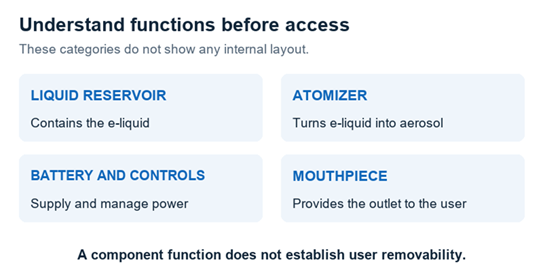
Functional categories only. They do not represent a particular device layout, wiring or removal sequence.
Establish What Your Exact Model Permits
Match the Product and the Intended Operation
Find the complete model name and version on the packaging, label, or leaflet. Locate the corresponding official instructions and identify the operation you want to perform. Instructions for charging, replacing a designed pod, or removing shipping protection do not automatically permit any other kind of access.
The FDA’s battery care guidance advises reading the manufacturer’s recommendations and contacting the manufacturer if instructions are absent or unclear. Use that route when you cannot match a pictured part to your device.
A useful check is whether the instructions name the component, show the operation for your model, and explain what to do afterward. If you have only a similar-looking video and a tool list, you still lack model-specific instructions. The fact that a casing can physically be separated does not establish that it can be restored to a usable condition.
Distinguish Shipping Protection From the Housing
The GEEKBAR HERO manual makes the distinction concrete. Its first-use directions identify a top silicone plug and bottom sticker for removal. The manual also identifies a non-replaceable battery and tells users not to open or tamper with the product.
For that named model, removing the specified shipping protection is a setup operation. It does not authorize removing the mouthpiece assembly, opening the base, or extracting the battery. Do not transfer those specific covers or instructions to a different Geek Bar model without checking its own leaflet.
If a different product has a documented user-replaceable pod, follow its exact replacement procedure. A removable pod still does not establish a removable battery or refillable liquid section. Keep the permissions for those operations separate.
Choose the Next Step for the Actual Problem
The Device Will Not Produce Vapor
Begin with its documented external checks, provided it is intact and shows no signs of damage. Record what its indicators actually do and when the fault started. A non-working device does not identify a failed internal connection by itself.
Our guide to a disposable vape that will not hit explains how to approach battery status, liquid status, and external setup checks. If those checks do not resolve the issue, contact support with the model and symptoms. Opening the shell is not a diagnostic conclusion.
You Want to Clean the Mouthpiece
Check the permitted care method for the contact surface and accessible exterior. Removing surface dirt is a different task from separating a sealed mouthpiece assembly or washing the internals. Follow the manufacturer instructions without inserting tools into unknown openings or adding liquid to the device.
Tell support if a suspected cleaning problem is actually recurring liquid leakage or a loose, broken part. That description matters more than trying to make the device look intact again.
You Want to Recharge or Reach Remaining Liquid
Determine rechargeability from the exact model’s instructions and intended external connection. The presence of a battery inside does not mean there is a supported way to reach and recharge it directly. The HERO example is rechargeable yet still has a non-replaceable battery and a no-opening warning.
Likewise, liquid visible in a product does not make its reservoir refillable or give it a user opening point. Do not turn a forced mouthpiece removal into a refill or liquid-recovery procedure. If the liquid system is sealed, keep it closed and ask the manufacturer about the original fault or end-of-use condition.
You Want to Separate Materials for Recycling
Confirm the receiving program’s whole-device instructions before doing anything to the casing. The EPA’s e-cigarette collection guidance warns against extracting embedded batteries or cartridges. That document is written for collectors; it is not a household dismantling manual.
Wanting to recycle the battery is a good reason to find an appropriate service, not to invent an extraction method. A collection box intended for loose batteries is not necessarily a destination for a complete vape.
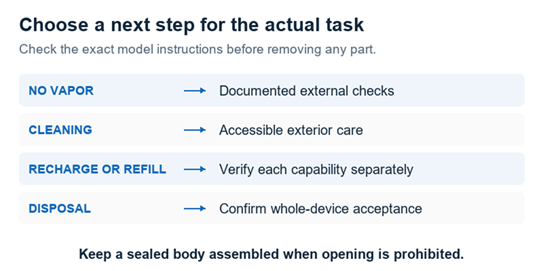
The purpose of access determines which documented instruction or support route to use.
If the Casing Is Already Open or Damaged
Stop using or charging the device and describe what happened to the manufacturer or seller. Do not reconnect wiring, press internal parts together, or activate it to see whether a repair worked. A casing that clicks back into place does not verify the condition of what it encloses.
The EPA’s household battery guidance notes that batteries can retain hazardous energy after they appear discharged and that not all batteries are user-serviceable. A dark indicator or lack of vapor is therefore not permission to handle exposed battery connections.
Avoid contact with exposed nicotine liquid and keep the product away from children and pets. The FDA’s e-liquid exposure guidance says to wash affected skin thoroughly with soap and water after accidental contact. Do not interpret that as an instruction to rinse exposed electronics.
If there is smoke, fire, or another sign of active battery failure, keep your distance and seek emergency help instead of trying to close or package the device. For a lithium-ion battery fire in the US, the US Fire Administration advises evacuation and calling 911. Outside the US, use the appropriate local emergency service.
Prepare a Useful Support or Collection Request
For an ordinary support inquiry, explain the original problem before describing any action you took. Include:
- The complete model name and version, if shown.
- The task you intended, such as external cleaning, charging, or investigating no vapor.
- The exact external part or protection already removed.
- Any cracks, loose parts, leakage, unusual heat, or exposed components.
- Which instructions you followed and when the problem began.
Take an exterior photograph only if doing so does not require handling a hazardous device. Do not open it further to provide a better view. Keep purchase and packaging information available if the seller needs it, but ask about the actual written support terms rather than assuming a refund or warranty outcome.
For disposal, describe the unit’s current condition accurately and ask whether a complete device is accepted. Our disposable vape disposal guide explains what to confirm before arranging a household collection. An opened or damaged vape should not be presented as an ordinary intact unit.
Frequently Asked Questions
Should I Remove the Bottom Cap First
There is no universal first cap. A bottom sticker identified in a setup leaflet may be shipping protection; the housing beneath it may remain sealed. Follow only the operation identified for the complete model name.
Can a Dead Vape Still Have a Charged Battery
Yes. Failure to produce vapor does not prove that the battery has no remaining energy. Treat the built-in battery according to the device instructions rather than using performance or screen status as an electrical test.
Can I Reuse the Battery in Another Project
Do not treat a sealed disposable as a source of user-removable cells. If its battery is embedded or non-replaceable, keep it in the device and seek a suitable whole-device collection route. This guide does not establish a battery’s suitability for another use.
Does a Screen Mean the Device Is Repairable
No. A display is a feature, not a declaration of user serviceability. Check the official maintenance and replacement instructions. A screen-equipped model can still have a sealed body and non-replaceable components.
Do Plastic Tools Make Disassembly Acceptable
A different tool material does not establish the internal layout or manufacturer permission. If opening the housing is prohibited or undocumented, choosing a plastic tool does not supply the missing procedure.
What If I Have Lost the Leaflet
Look for the official instructions using the complete model name, or contact the manufacturer. A manual for another version or a social-media teardown should not be substituted simply because its casing looks similar.
Sources and Further Information
Sources checked October 20, 2026. The HERO example concerns that specific model. Component functions are explanatory categories, not a universal internal layout or disassembly procedure. Emergency guidance is identified for US readers.
- FDA overview of ENDS and components — component categories and aerosol production.
- FDA vape battery precautions — manufacturer use and care instructions.
- GEEKBAR HERO instructions — shipping covers, non-replaceable battery, and prohibition on opening or tampering.
- EPA e-cigarette collection tip sheet — collector guidance on embedded batteries and cartridges.
- EPA used household batteries — residual energy and limits of user serviceability.
- FDA e-liquid exposure guidance — skin exposure and precautions around children and pets.
- US Fire Administration battery guidance — US emergency response to a battery fire.
 9000 Puff Vapes
 12000 Puff Vapes
 15000 Puff Vapes
 20000 Puff Vapes
 30000 Puff Vapes
 40000 Puff Vapes
 50000 Puff Vapes
 60000 Puff Vapes
 80000 Puff Vapes
 100000 Puff Vapes