







Blog
How to Get Rid of Disposable Vapes

To get rid of a disposable vape, find a collection program that explicitly accepts the whole device, including its built-in battery and any remaining e-liquid. In the United States, the EPA recommends household hazardous waste collection. Keep sealed devices intact and confirm the receiving site’s requirements before taking them there.
Do not put an intact vape in household trash or ordinary curbside recycling. If it is damaged, leaking, unusually hot, or smoking, its condition changes what you should do next. This guide focuses on household nicotine-vape waste in the US, with a separate section for UK readers.
Check the Device Before Choosing a Disposal Route
Intact Unwanted Devices
A device does not have to be completely empty before you arrange disposal. Start by noting what you have: a sealed disposable, whether liquid remains, and whether there is visible damage. You need that description when asking a collection service about acceptance.
You do not need to open the casing to identify the battery or drain the reservoir. The task is to find the right destination for the product in its present condition.
Leaking Swollen or Damaged Devices
Tell the collection operator about cracks, swelling, leakage, or other damage before making a trip. A site that accepts ordinary used vapes may have a different route for damaged ones.
For example, San Francisco Environment’s vape guidance excludes damaged, swollen, defective, or recalled batteries from standard drop-off sites and directs residents to a separate handling service. That is a local example, not a nationwide pickup entitlement.
Do not wipe a recurring leak and treat the device as an ordinary intact unit. Our disposable vape cleaning guide explains the distinction between accessible surface residue and liquid that returns after wiping.
A Device That Is Hot Hissing or Smoking
Unusual heat, bulging, or hissing are stop-use warnings in the London Fire Brigade’s vaping guidance. Do not continue charging or using the device, and do not try to bag it or drive it to a collection point while it is showing signs of failure.
Keep your distance. If a battery fire occurs, evacuate and contact emergency services. The US Fire Administration advises evacuation and calling 911 for a lithium-ion battery fire. Outside the US, use the appropriate local emergency number. An active battery incident needs an emergency response, not a recycling appointment.
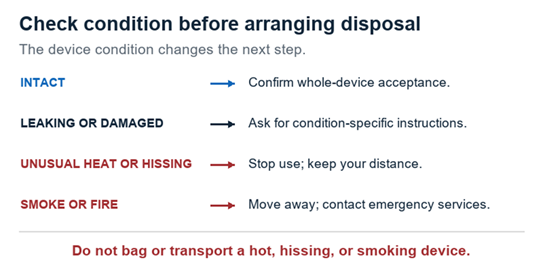
Check the condition first. Do not bag or transport a hot, hissing, or smoking device.
Find a Collection Site That Accepts the Whole Vape
US Household Hazardous Waste Programs
Search your city or county’s official website for household hazardous waste, often abbreviated HHW. Look for vape-specific instructions, then confirm whole-device acceptance, household eligibility, and any condition restrictions with the operator. Your local solid waste agency can help identify the relevant program.
Confirmed Retail or Manufacturer Take Back Programs
A retailer or manufacturer may offer another route, but verify the program before relying on it. Ask whether it accepts complete disposable nicotine vapes, not just loose batteries, pods, or its own brand’s products.
A battery collection logo is insufficient confirmation. The Battery Network’s FAQ says its collection boxes do not accept disposable vapes or e-cigarettes when their batteries cannot be removed and fully separated. Do not dismantle a sealed device to try to make it qualify.
UK Vape and Electrical Recycling Options
UK readers can use the Recycle Your Electricals vape guide and recycling locator. Its guidance says that a vape with a built-in battery should go into the appropriate electrical recycling route as a whole device.
Check the named site’s current vape acceptance instructions, especially for damaged products. Do not transfer a UK retailer’s arrangements to a US store or assume every electrical or battery collection point accepts the same items.
Ask These Questions Before You Leave Home
Confirm the details with the actual receiving program. A useful phone or email message is:
“I have used disposable nicotine vapes with built-in batteries, and some may still contain e-liquid. Do you accept the complete devices? One is [describe any damage or leakage]. What do I need to do before bringing them in?”
Then ask about:
- Eligibility, including residency requirements and whether the service is for households.
- Appointments, opening arrangements, quantity limits, and fees.
- Whether the device’s condition changes the destination or acceptance rules.
- The program’s specific preparation, packaging, and transport instructions.
For a concrete example, Clark County Public Health lists whole-device collection for residents, including cartridges with or without liquid, but also states a quantity limit. It separately excludes business-generated vape waste from those residential locations. These details show why a general “vapes accepted” listing is only the start of the check.
| Possible route | What to confirm | What not to assume |
| Local HHW program | Whole-device acceptance and household eligibility | Every collection accepts every condition |
| Retailer or manufacturer program | Product types, brands, and current arrangements | Selling vapes means accepting all returns |
| Ordinary battery collection box | Explicit acceptance of an intact vape | Acceptance of batteries includes complete vapes |
| Damaged-device service | Condition-specific handling and collection | Standard drop-off instructions still apply |
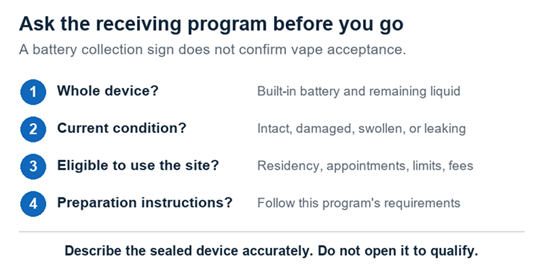
Confirm acceptance of the complete device, its condition, your eligibility, and the receiving program’s instructions.
Record the program’s name and instructions so you can follow the same arrangements when you arrive. If a directory and the receiving site disagree, confirm directly with the operator rather than leaving the device at an unattended box.
Keep Sealed Devices Intact While Arranging Disposal
Leave built-in batteries and sealed reservoirs in place. San Francisco’s guidance explicitly warns against removing batteries designed to be non-removable. Avoid prying, crushing, puncturing, rinsing, or pouring liquid out to prepare a disposable for collection.
For an intact device awaiting collection, follow the manufacturer’s storage instructions and the receiving program’s preparation directions. The FDA’s vape battery guidance recommends reading the manufacturer’s care instructions and protecting the device from extreme temperatures. Do not leave it in a hot car or direct sunlight while planning a drop-off.
Keep it away from children and pets. FDA guidance on accidental e-liquid exposure explains that nicotine-containing liquid can be dangerous through contact or swallowing. If liquid gets on your skin, wash the area thoroughly with soap and water. That instruction is for skin exposure, not for washing the device.
Do not run the battery down or finish the liquid merely to prepare disposal. Do not open a casing to reach terminals for taping. Any packing instructions should apply to the actual device and its condition; ordinary storage advice is not a method for managing an overheating or venting battery.
Avoid These Common Disposal Mistakes
Using Household Trash or Ordinary Recycling
An intact vape is a battery-containing device, not just a plastic shell. The EPA’s household battery guidance explains why lithium batteries need appropriate collection rather than household garbage or municipal recycling bins. Vape-specific programs must also account for the remaining liquid and other components.
Assuming Empty Means Harmless
A device that no longer produces aerosol still needs the correct disposal route. Battery collection guidance from The Battery Network notes that batteries unable to power a device may still retain enough charge to cause a short-circuit hazard.
If you are unsure about liquid depletion, see how to tell whether a disposable vape is almost empty. That helps answer a separate use question; it does not establish that the device belongs in a trash or recycling bin.
Draining or Taking Apart the Device
Do not pour nicotine liquid into a sink or drain, burn a device, or pull it apart to sort the materials yourself. The EPA’s e-cigarette collection guidance specifically addresses embedded batteries and nicotine waste. Its detailed collection requirements are written for collecting businesses, so they should not be mistaken for a household packing checklist.
What to Do If No Nearby Site Accepts Vapes
Ask your local solid waste or HHW authority what route it recommends for intact nicotine-vape devices. Be specific about the embedded battery and any damage. Ask whether a suitable collection event or another approved service is available.
You can also contact the manufacturer for a verified product-specific option. Request current acceptance instructions rather than assuming a general return address accepts waste. Do not leave devices beside a full or unsuitable collection box.
Mailing requires a separate check. USPS describes electronic nicotine delivery systems as generally nonmailable unless an applicable exception and its conditions are met. A recycling purpose alone is not a substitute for verifying an authorized arrangement, carrier acceptance, and the applicable requirements. Do not improvise an ordinary parcel, particularly for a damaged device.
If the products are shop inventory, waste from another business, or cannabis devices, identify that when requesting help. Household nicotine-vape guidance does not establish the route for those products. Keep business disposal outside a residential program unless the operator explicitly permits it under the appropriate arrangements.
Frequently Asked Questions
Do Nicotine Free Disposable Vapes Still Need Special Disposal
Yes. A nicotine-free label does not remove the built-in battery. Check for a collection program that accepts the whole device rather than using household trash or ordinary recycling.
Can I Dispose of a Vape That Still Contains Liquid
Ask the receiving program about the complete device with liquid remaining. Clark County’s cited household guidance includes that situation, but acceptance elsewhere must be confirmed. Do not drain it first.
Is Vape Recycling Always Free
No universal price applies. EPA says household collections are typically free for residents, but verify eligibility, fees, and limits with the program you intend to use.
Can I Mail an Unwanted Disposable Vape for Recycling
Do not assume it is an ordinary mailable item. Use only a verified arrangement that accepts your product and condition and meets the carrier’s requirements. A battery-only return kit may not accept intact vapes.
What If I Cannot Find a Collection Site Near Me
Contact your local waste authority and manufacturer with the exact device description. Ask about a suitable service or upcoming collection. A nearby box that accepts a different item is not an equivalent alternative.
Can a Shop Use a Household Program for Unsold Stock
Do not assume so. Household and business-generated waste can follow different rules. The EPA collection guidance distinguishes them; a business should confirm its route with its waste authority or qualified service provider.
Sources and Further Information
Sources checked October 19, 2026. US guidance is the primary reference; UK resources are identified separately. Local examples and individual collection programs do not establish nationwide acceptance or pricing.
- EPA e-cigarette disposal information for individuals — US household collection route and waste hazards.
- San Francisco Environment vape disposal guide — local acceptance restrictions and non-removable batteries.
- London Fire Brigade vaping guidance — battery warning signs.
- US Fire Administration community education — battery-fire evacuation and US emergency response.
- The Battery Network FAQ — whole-vape exclusions and residual battery charge.
- UK Recycle Your Electricals vape guide — UK locator and built-in-battery collection route.
- Clark County Public Health disposal guidance — a named US household collection example and its limits.
- FDA vape battery precautions — care instructions and temperature precautions.
- FDA e-liquid exposure guidance — contact, swallowing, and storage precautions.
- EPA used household batteries guidance — lithium battery collection and disposal.
- EPA household e-cigarette collection tip sheet — collector guidance, embedded devices, and household versus business waste.
- USPS overview of ENDS mailing restrictions — general nonmailability and conditional exceptions.
 9000 Puff Vapes
 12000 Puff Vapes
 15000 Puff Vapes
 20000 Puff Vapes
 30000 Puff Vapes
 40000 Puff Vapes
 50000 Puff Vapes
 60000 Puff Vapes
 80000 Puff Vapes
 100000 Puff Vapes