







Blog
Vape Battery Care and Signs of Deterioration

Care for a vape battery through the exact device’s storage, handling and supported charging instructions. A change in runtime is an observation to investigate, while physical damage or signs of active failure call for stopping ordinary use. Neither the device’s age nor its printed capacity establishes a universal safe lifespan.
For adults with existing equipment, the goal is to recognize which question needs answering: routine care, a performance change, a damaged item or an emergency. Treating all four as a request to charge for longer can obscure the actual problem.
Separate battery capacity from the complete device
Battery energy powers the device, but it is not the liquid supply or the whole product’s intended service life. A sealed disposable can reach its liquid endpoint while its display still powers on. A reusable power unit can have a separate consumable that needs attention.
The US Fire Administration explains that lithium-ion batteries degrade over time through charging and discharging. This is general battery information, not a measured endurance result for a particular vape. It does not establish a fixed number of months or cycles for every product.
Record the actual model and its use history when asking about a change. Do not infer battery condition by repeatedly activating the item until it stops, and do not treat a puff claim as a battery test.
Build routine care from actual directions
FDA advises protecting vapes from extreme temperatures and following manufacturer use and care recommendations. Its guidance also places charging on a clean, flat, visible surface away from easily ignited materials. It is not a universal charging-time specification.
For a manufacturer example, Vuse’s Belgium FAQ tells ePod owners to keep the device and accessories dry and use the specified Vuse charging accessories. Its care directions concern that named system. They do not authorize the same accessory, cleaning product or storage limit for every vape.
Use your own product’s documented storage and cleaning method. Keep it out of conditions the manufacturer excludes. Do not invent a refrigerator, freezer or deliberate heating routine to improve performance.
Our disposable charging guide addresses the separate question of whether a specific design supports charging. A care routine starts with that permission; it cannot create a connection or charging task for a non-rechargeable model.
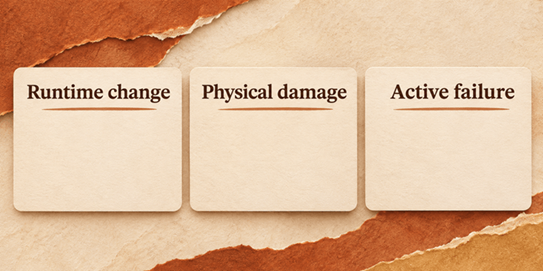
A performance observation, damage and active failure require different responses.
Investigate a runtime change without diagnosing it
Shorter time between charges can have more than one explanation. A meaningful comparison needs the same identified equipment and a record of ordinary conditions. A changed operating mode or pattern makes an earlier observation less comparable; time alone cannot distinguish those differences from deterioration.
Keep the description narrow: what changed, when it started, which device and consumable were involved, and what the actual indication said. Do not replace that record with a claim that a single blinking light proves a failed cell.
Nominal capacity in mAh is another specification, not a remaining-health percentage or a personal duration guarantee. A functioning screen also cannot establish the internal state of a battery. Avoid unsupported apps, improvised meters or opening a sealed housing to produce a more precise-looking assessment.
The printed product date answers a different question again. Our disposable expiry explanation distinguishes date interpretation from depletion and current condition. A product being within a date window does not remove the need to respond to damage.
Distinguish ordinary observations from warning signs
USFA lists bulging, mechanical damage, popping or hissing, venting gases and rising temperature among signs associated with damage or thermal runaway in lithium-ion batteries. Its page addresses general battery risks and professional response. These signs should not be repurposed as a household repair checklist.
| Observation | What it does not establish | Appropriate direction |
| Shorter ordinary runtime | A single proven internal cause | Record conditions and seek model-specific support |
| Damaged or deformed housing | That cleaning or a longer charge repairs it | Stop ordinary use and charging |
| Unexpected heating or venting | That the item can be handled routinely | Keep clear and seek urgent appropriate help |
| Smoke or fire | A routine charging problem | Move away and contact emergency services |
Do not press a swollen casing flat, puncture it, open it to inspect the cell or attempt to revive the item. If smoke or fire occurs, move away, leave the affected area and contact local emergency services. Do not attempt firefighting or carry the item through occupied spaces.
This distinction prevents a performance inquiry from becoming continued handling of an actively failing device. It also avoids calling every ordinary runtime difference an immediate internal diagnosis.
Keep a useful support record
Retain the model, original instructions and accessible identifying information. Describe the observation and any relevant event, such as a drop or liquid exposure. Do not recreate the event or repeat a charge to provide a demonstration.
Ask whether the manufacturer recommends inspection, replacement or retirement given that actual condition. A routine consumable change is not automatically a battery repair, and an intact appearance after wiping does not establish that liquid exposure caused no damage.
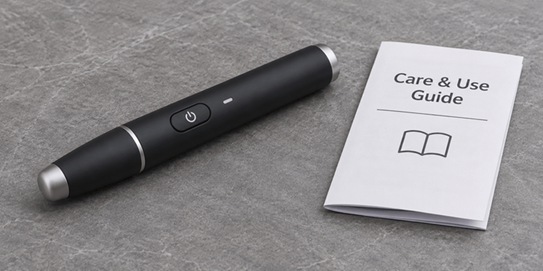
Follow the exact care directions; this illustrative scene does not certify battery condition.
The useful outcome is an appropriate next action, not a guaranteed extension of service life. Avoid promises that a particular charge percentage, number of cycles or overnight routine will make an unidentified battery last longer.
Plan the endpoint without extracting the battery
When retirement is advised, identify a receiving route that accepts the complete device in its actual condition. A damaged item may require different advice from an intact spent one. Explain the condition before taking it to a collection point.
Our whole-device disposal guide covers the questions to ask for US household collection. Other locations and commercial waste require their own arrangements. Do not assume that every battery bin accepts a complete vape.
Keep sealed equipment assembled. Do not extract an embedded cell, drain liquid or repeatedly activate the device to make it seem empty before disposal. Apparent electrical depletion is not a certificate that the item has no remaining hazards.
Frequently asked questions
Is there a universal replacement cycle count
No. General information about battery aging does not establish a service interval for every vape. Use the actual manufacturer’s condition and maintenance directions.
Can mAh tell me the battery health
Nominal capacity is not a current battery-health measurement. It does not identify the cause of a runtime change.
Can freezing restore a weak battery
Do not invent a freezing or heating routine. Follow the actual storage directions and seek support for a performance change.
Does wiping a wet device make it suitable to charge
An exterior wipe cannot establish internal condition. Stop routine use and charging after suspected damage or liquid ingress and seek manufacturer guidance.
Can I charge an unidentified model to test it
Do not create a charging task without confirming the model’s intended method. Opening the casing or attaching wires is not identification.
What should I do about swelling
Stop ordinary use and charging. Do not press, puncture or open the item. Keep clear of active failure and seek appropriate urgent help; smoke or fire requires emergency services.
Sources and Further Information
Source check date: November 3, 2026. Vuse ePod is a named care example. USFA provides general lithium-ion risk information; professional response procedures are not household instructions. No battery was tested or opened.
 9000 Puff Vapes
 12000 Puff Vapes
 15000 Puff Vapes
 20000 Puff Vapes
 30000 Puff Vapes
 40000 Puff Vapes
 50000 Puff Vapes
 60000 Puff Vapes
 80000 Puff Vapes
 100000 Puff Vapes