







Blog
Vape Device Types and Safety Basics for Existing Adult Users

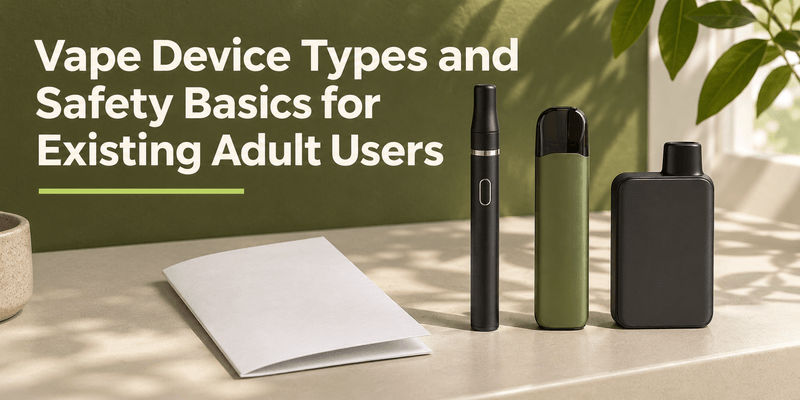
Identify an existing vape by its exact model and how its liquid supply and consumables are intended to be handled. Disposable, prefilled-pod and refillable describe different arrangements. Shape, a charging port or a screen cannot by itself establish which tasks the owner is permitted to perform.
This guide helps adult owners classify equipment before looking for operating instructions or replacement parts. It does not recommend starting vaping, rank a safest category or replace the directions for a particular model. Identification is the first step because an instruction for the wrong design can lead to the wrong action.
Begin with the liquid and consumable system
CDC describes disposable devices, refillable devices and devices using prefilled cartridges or pods. Its overview explains that a disposable can be rechargeable without being designed for refilling. It also describes prefilled-pod systems intended for reuse and refillable systems with a chamber for liquid.
The important distinction is what remains in service when a consumable is finished. In one design, the complete item reaches its endpoint. In another, the power unit remains while an identified pod is exchanged. In a refillable design, liquid can be added through the intended filling system, subject to its instructions.
| Family description | Relationship to confirm | Information still needed |
| Prefilled disposable | Original liquid supply belongs to the complete item | Whether charging is supported and its endpoint |
| Prefilled pod system | Compatible prefilled pod used with a reusable unit | Exact pod and power-unit identification |
| Refillable system | Liquid added through an intended filling system | Permitted liquid and serviceable consumables |
This is an orientation table, not a specification for every product carrying one of these names. A category narrows the questions; the exact model answers them. Do not fill a closed pod simply because another pod system can be refilled.
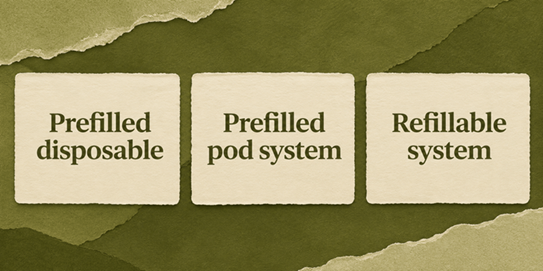
Identify the consumable system before looking for a permitted operation.
Preserve the exact product identity
Look for the complete model name, version and identifying information on the original packaging, device and instructions. Keep these together. A brand can sell several designs with different controls and consumables, so the brand name alone is incomplete.
Compare the actual identifiers before using a manual found online. Similar spelling, a shared flavor name or a matching exterior color does not establish the same model. If the leaflet and item do not match, preserve the discrepancy and ask the manufacturer which instructions apply.
Our guide to actual model instructions covers the next operational step. First identify the product; then follow its directions. Copying another model’s button sequence or charging signal reverses that order.
When identification is missing, do not open a sealed casing to search for a battery label. A photograph of accessible identifying information and the original box can support an inquiry without inventing an inspection task.
Separate the resources and replaceable units
Battery energy and liquid supply are different resources. A charged battery does not establish that liquid remains, and remaining liquid does not establish that a battery can be charged. A device’s supported electrical task and its liquid task must be checked separately.
The heating component can also have a different maintenance boundary. A device may use a separately replaceable coil, a whole pod with an integrated heater, or a sealed assembly. The word refillable does not identify which arrangement applies.
Our maintenance and device limits comparison explains how these permissions affect care. Before ordering a replacement, record the full consumable designation. Similar dimensions or a shared brand do not demonstrate compatibility.
For the underlying mechanism, how vapes work explains the roles of energy, liquid and heating. Understanding those functions is useful; it does not establish that the corresponding physical parts can be removed from your item.
Read controls within the model instructions
A screen may report only the functions assigned by the manufacturer. It is not evidence of a refill opening, replaceable battery or accurate remaining lifespan. Likewise, a light may indicate different conditions on different models.
Do not interpret an unfamiliar symbol by borrowing the meaning from a similar-looking device. Preserve the exact message and consult the matching directions. A control that changes an operating mode does not establish that all available liquid or replacement parts are suitable.
FDA recommends reading and understanding manufacturer use and care directions and contacting the manufacturer when instructions are missing or unclear. This provides a sensible response to uncertainty without making up a universal startup or reset procedure.
Check condition before considering an ordinary task
Correct identification does not certify current condition. A known product can still be damaged, leaking or otherwise abnormal. If it is unusually hot or physically damaged, stop ordinary use and charging and seek condition-specific guidance instead of proceeding through a routine checklist.
Keep a separate record of identity and observation. The first answers what product this is; the second describes what happened to this particular item. Neither should be used to fabricate a diagnosis from an unfamiliar light or a single symptom.
Keep the complete model identity and its matching instructions together.
A clean exterior, intact-looking package or powered screen is not a complete equipment assessment. Do not repeatedly activate an uncertain item to see whether it works well enough to fit a category.
Resolve the missing question precisely
Ask the manufacturer a focused question: which model is this, which consumable does it use, and what documented task is permitted when that consumable is finished? If charging is the issue, request the actual charging directions. If identification is the issue, settle that before discussing operating settings.
The practical result can be an applicable instruction, a confirmed consumable or advice to retire the item. It need not be a way to keep every device working. Keep sealed equipment assembled and confirm the receiving route for the complete product when retirement is required.
This identification process allows existing owners to find the correct next resource without turning a broad category into permission to fill, dismantle or modify a device.
Frequently asked questions
Does a charging port mean refillable
No. Charging and adding liquid are separate capabilities. CDC explicitly notes that disposables may recharge without being designed for refilling.
Can every pod be refilled
No. Confirm whether the actual pod is prefilled and closed or intended for filling, and use the matching instructions.
Does a screen identify the device type
No. It reports the functions assigned to it. The exact model and consumable system still need identification.
Can I use a manual with a similar name
Only after confirming it applies to the exact model and version. Ask the manufacturer about a mismatch rather than copying its procedure.
Does a flat battery mean the whole item is empty
It does not establish liquid level or the intended endpoint. Follow the model’s separate indications and supported tasks.
What if there is no leaflet
Use accessible product information to contact the manufacturer. Do not open the casing or invent controls to identify the design.
Sources and Further Information
Source check date: November 3, 2026. Categories are an orientation aid, not current stock descriptions, product recommendations or a health ranking. No device was opened or tested.
 9000 Puff Vapes
 12000 Puff Vapes
 15000 Puff Vapes
 20000 Puff Vapes
 30000 Puff Vapes
 40000 Puff Vapes
 50000 Puff Vapes
 60000 Puff Vapes
 80000 Puff Vapes
 100000 Puff Vapes